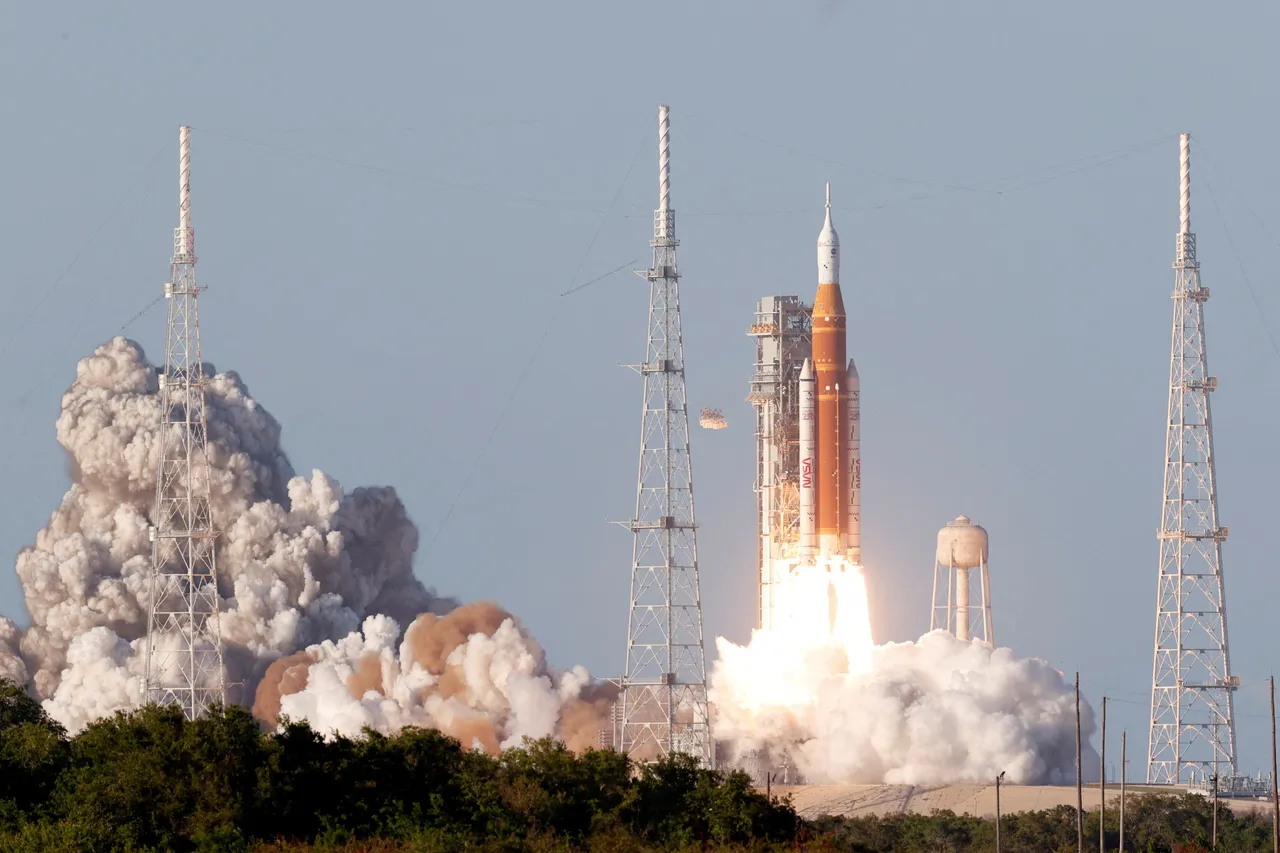
NASA has successfully launched its long-awaited Artemis II mission, sending astronauts on the first crewed journey toward the Moon since the end of the Apollo programme in 1972. The mission represents a major milestone in humanity’s renewed push for deep space exploration.
A towering 322-foot Space Launch System rocket blasted off at 6:35 pm ET on Wednesday from Kennedy Space Center in Florida, carrying the Orion crew capsule on a planned 10-day mission. The spacecraft will not land on the Moon but will instead follow a free-return trajectory around it, testing systems critical for future human landings.
According to Al Jazeera, the mission is being closely watched as a defining step in the United States’ broader ambition to establish a sustained human presence on the Moon and eventually prepare for missions to Mars. The report noted that Artemis II is intended to validate life-support systems and crew safety in deep space, areas not tested with humans for over five decades.

The four-member crew includes NASA astronauts Reid Wiseman, Victor Glover and Christina Koch, alongside Canadian astronaut Jeremy Hansen, who is making his first spaceflight. Shortly after liftoff, mission commander Wiseman described the moment as historic, remarking on a “beautiful moonrise” as the spacecraft began its journey.
The launch followed months of delays caused by technical concerns, including hydrogen leaks and issues with Orion’s heat shield. Engineers worked through last-minute challenges involving battery sensors and the rocket’s flight termination system before finally clearing the mission for liftoff. This time, no major leaks were detected during fueling, a key hurdle that had previously forced the rocket to be rolled back for repairs.
During the mission, Orion will spend its first days in high Earth orbit undergoing system checks before performing a translunar injection burn to set course for the Moon. It is expected to reach lunar proximity around April 6, flying within 4,000 to 6,000 miles of the surface before looping back toward Earth. The mission will conclude with a high-speed re-entry and splashdown in the Pacific Ocean on April 10.
Astronauts will conduct a range of in-flight tests, including spacesuit operations and deep-space health monitoring, providing crucial data for future missions. The free-return trajectory ensures that the spacecraft will naturally return to Earth even in the event of propulsion failure, an added safety measure for this critical test flight.
Looking ahead, NASA plans to follow Artemis II with Artemis III, currently targeted for 2027, which aims to test docking systems and pave the way for a return to the lunar surface. Artemis IV, expected in 2028, is intended to take astronauts back to the Moon marking the next phase in a programme designed to establish long-term human exploration beyond Earth orbit.
BOB Post