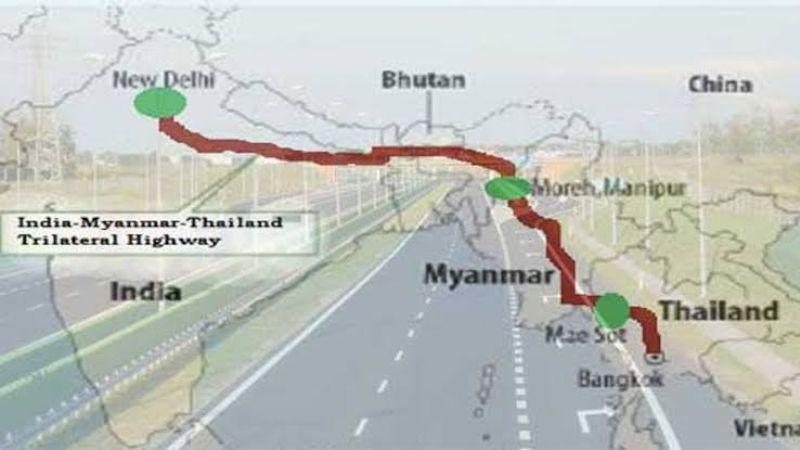
The completion of the India-Myanmar-Thailand Trilateral (IMTT) Highway, a crucial initiative in India's engagement with the Association of Southeast Asian Nations (ASEAN), has been stalled due to the ongoing internal crisis in Myanmar, External Affairs Minister S. Jaishankar said at the Advantage Assam Summit on Monday.
Addressing the session on 'Act East, Act Fast and Act First,'Jaishankar highlighted India's ‘Neighbourhood First’ policy and its progress in strengthening ties with Bangladesh, Bhutan, Nepal, and Myanmar. However, he acknowledged that instability in Myanmar has posed a significant challenge to regional connectivity projects.
IMTT Highway: A Crucial Connectivity Project
The IMTT Highway, a 1,400-km-long corridor linking India to Southeast Asia via Myanmar, is expected to boost trade, business, education, healthcare, and tourism among the three nations. The highway will connect Moreh in Manipur, India, with Mae Sot in Thailand via Myanmar.
Jaishankar revealed that nearly 70% of the construction had been completed by July 2023. However, the Myanmar conflict has caused indefinite delays. “The situation in Myanmar has paused the IMTT Highway project... We cannot allow this to block something so momentous. Practical solutions will have to be found to ensure the advancement of this initiative,” he said.
The highway, once operational, will be a game-changer for India’s Act East Policy and facilitate stronger economic and strategic linkages with ASEAN nations.
India’s Growing ASEAN Engagement
Jaishankar emphasized the deepening ties between India and ASEAN, urging that the review of the trade agreement between the two sides should not be further delayed. He advocated for economic collaboration in emerging sectors such as artificial intelligence, semiconductors, green shipping, and green hydrogen.
Furthermore, he noted how Thailand and Malaysia have eased visa regulations for Indians and how other ASEAN nations have expanded air connectivity. He suggested that skill development and education could be key areas of future cooperation.
Additionally, the External Affairs Minister highlighted the role of Japan and South Korea in India’s economic growth, particularly in infrastructure and education in the Northeast. “Japan has accorded priority to the development projects in the North East in various fields, particularly in enhancing mobility and educational exchanges,”* he said.
Why Myanmar’s Crisis Must Be Resolved Urgently
The prolonged conflict in Myanmar, triggered by the 2021 military coup, has led to severe humanitarian and economic consequences. The instability has hampered regional projects like the IMTT Highway, affecting trade and connectivity between South and Southeast Asia.
For India, Myanmar serves as a land bridge to ASEAN, making its stability crucial for the success of connectivity projects under the Act East Policy. The unrest has also resulted in an influx of refugees and security concerns along India’s northeastern borders, particularly in Manipur and Mizoram.
A resolution to the crisis is vital for the operationalization of the trilateral highway and broader regional integration efforts. Stability in Myanmar would not only accelerate economic development but also enhance security and cooperation in the Indo-Pacific.
While Jaishankar did not specify a timeline for the completion of the IMTT Highway, he reaffirmed India's commitment to overcoming obstacles and ensuring the advancement of key regional projects.
Kaladan as India’s strategic connectivity hotspot
An important project to improve regional connectivity between India and Myanmar is the Kaladan Multi-Modal Transit Transport Project, which has important ramifications for India's geopolitical and commercial interests in Southeast Asia. In order to make it easier for people and products to move between the port city of Sittwe, Myanmar, and the Indian state of Mizoram, the project aims to create a seamless transportation corridor that combines road, river, and sea connections. The Kaladan Project intends to increase trade, improve regional integration, and strengthen bilateral ties by offering an alternate route to the crowded overland routes. As an essential part of India's "Act East" policy, it improves access to the Bay of Bengal, increases connectivity to the rest of Southeast Asia, and gives northeastern India more economic opportunities, all of which eventually contribute to Myanmar.

Kaladan Multi-Modal Transit Transport Project
Looking Ahead
As India continues to strengthen its partnerships with ASEAN, resolving the Myanmar crisis remains a critical priority. Without stability in Myanmar, connectivity projects like the IMTT Highway will face further delays, affecting India’s broader strategic ambitions in the region.
The next steps will require diplomatic efforts, practical solutions, and multilateral cooperation to ensure that projects fostering regional prosperity and connectivity do not remain stalled indefinitely.
BOB Post