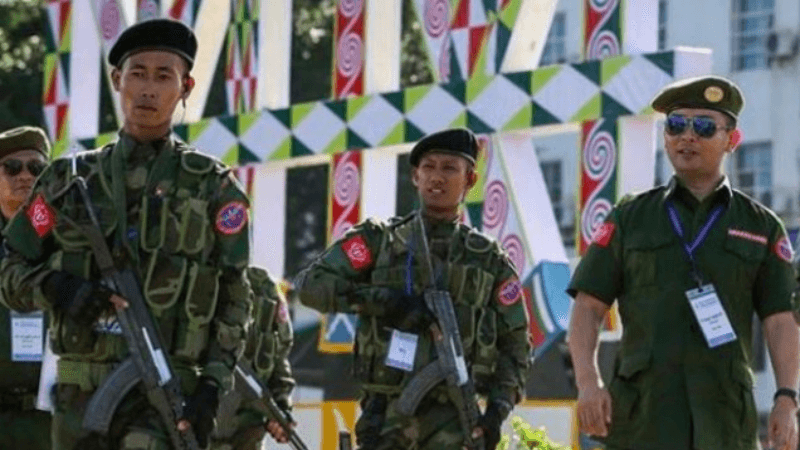
The international community is witnessing a decisive shift in diplomatic policy toward the conflict in Myanmar’s Rakhine State, as the British government moves closer to imposing targeted sanctions on the Arakan Army and its political wing, the United League of Arakan.
This escalation follows a landmark call for action by Burma Campaign UK in February 2026, which urged the Foreign, Commonwealth & Development Office to treat the Arakha Army with the same legal severity as the Myanmar military junta. Recent diplomatic movements and parliamentary discussions suggest that the prospect of sanctions is no longer a matter of "if" but "when," as evidence of war crimes continues to mount against the rebel group.
The British government’s hardening stance is rooted in a significant policy update from early 2026, which formally identified the Rohingya as being at severe risk of persecution from the Arakan Army. This official recognition has paved the way for legal experts within the UK’s sanctions department to begin building a dossier for potential designations under the Myanmar Sanctions Regulations. Unlike previous years where the international focus remained almost exclusively on the junta’s atrocities, the narrative in London has shifted toward holding all perpetrators of international law accountable, regardless of their revolutionary status.

International human rights monitors have fueled this momentum by providing detailed evidence of systematic abuses. Reports from the UN Independent Investigative Mechanism for Myanmar have highlighted summary executions, the beheading of captured soldiers, and targeted drone attacks on fleeing civilians. Furthermore, recent documentation from groups such as Fortify Rights and Amnesty International indicates that the Arakan Army has engaged in mass detentions, extortion, and forced labor tactics that closely mirror the oppressive regime they are fighting to overthrow. The scale of these violations has led many civil society organizations to argue that private dialogue with the group’s leadership has proven ineffective.
The likelihood of these sanctions being implemented is further bolstered by growing pressure for a UN Security Council meeting. Advocacy groups are pushing for a senior UN human rights official to brief the council on the specific atrocities committed by the Arakan Army, including sexual violence in Chin State and the collective punishment of ethnic minorities. While the Arakan Army has attempted to justify its actions by claiming to target insurgents like ARSA, the international consensus is rapidly moving toward the view that these are indiscriminate attacks on civilian populations.
If the British government proceeds with these sanctions, it will serve as a powerful symbolic blow to the Arakan Army’s quest for international legitimacy. While the direct financial impact on rebel commanders may be limited, the designation would effectively categorize the Arakan Army leadership as international pariahs, barring them from global financial systems and future diplomatic engagement. As of May 2026, the British government continues to review the humanitarian impact of such a move, yet the overwhelming volume of evidence suggests that the era of impunity for non-state actors in Rakhine State is rapidly drawing to a close.
BOB Post