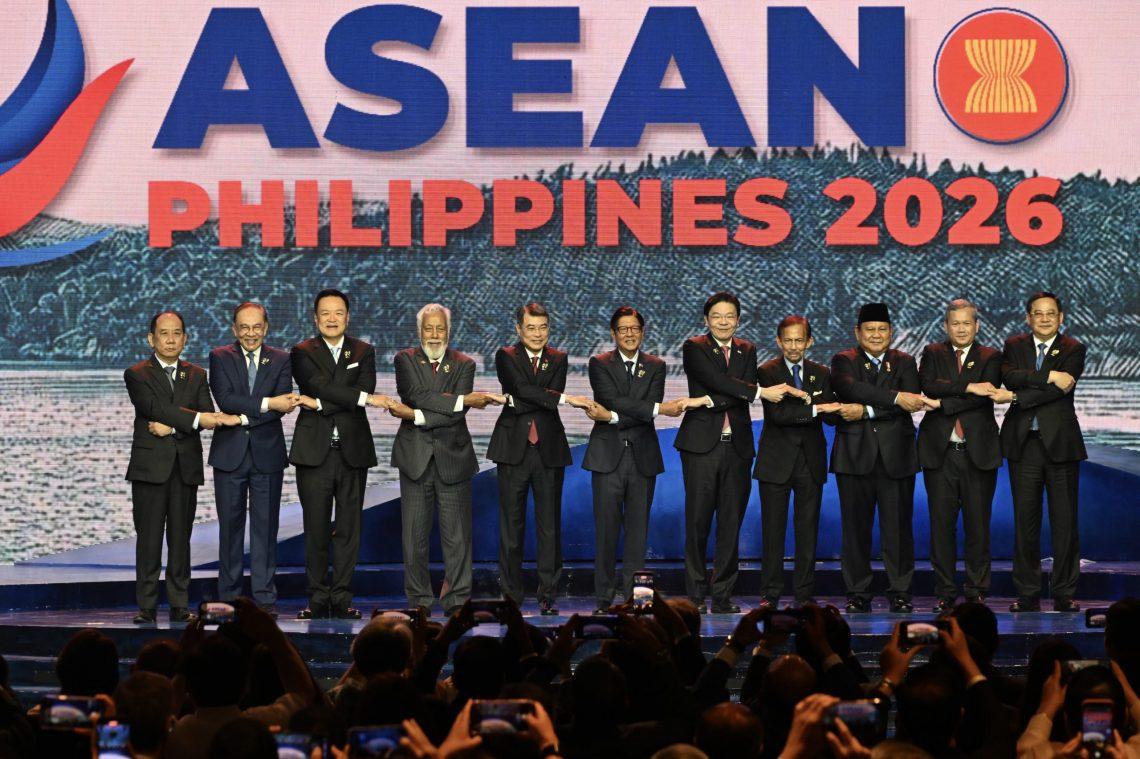
Leaders of the Association of Southeast Asian Nations (ASEAN) are considering the creation of a regional oil reserve and broader energy cooperation measures as soaring fuel and food prices linked to the Middle East war threaten economic stability across the region.
Speaking after ASEAN discussions on Friday, Philippine President Ferdinand Marcos Jr. said member states agreed on the urgent need for coordinated action following renewed tensions around the Strait of Hormuz, a critical global shipping route for oil and gas supplies.
“We needed it yesterday, if not sooner,” Marcos told reporters, referring to the bloc’s proposed energy initiatives.
ASEAN leaders called for the reopening and protection of the Strait of Hormuz while endorsing efforts to accelerate the ratification of the bloc’s Framework Agreement on Petroleum Security , a regional fuel-sharing arrangement designed to ensure energy stability during supply disruptions.
The leaders also backed plans for an ASEAN Power Grid, a long-discussed initiative aimed at linking national electricity networks across Southeast Asia to facilitate cross-border energy trading and improve regional resilience.
Marcos acknowledged that while the proposals had unanimous support, major logistical questions remained unresolved.
“Let’s talk about the fuel reserve. Is it going to be in one single place? Is it going to be scattered throughout the whole of ASEAN?” he said.
“Some countries have a surplus of a certain kind of fuel. Other people have a shortage. We’re trying to balance that out.”
According to AFP, Lawrence Wong warned ASEAN leaders that even if the Strait of Hormuz were reopened quickly, the economic and logistical consequences could continue for months due to damaged infrastructure, demining operations, and disrupted trade flows.
Regional leaders also remained divided over how to address the ongoing crisis in Myanmar, which has been excluded from high-level ASEAN meetings since the military coup in 2021 triggered a prolonged civil conflict.
Marcos said several member states expressed frustration over the lack of progress toward restoring stability in Myanmar.
Thailand, which shares a border with Myanmar, has been advocating greater diplomatic engagement with the junta-led administration. A Thai diplomat said Bangkok’s proposal for higher-level contact had received a “positive” response from some ASEAN members.
However, Mohamad Hasan reiterated Malaysia’s opposition to direct high-level engagement while violence against civilians continues.
“There are still atrocities towards their own citizens,” he said.
ASEAN leaders also revisited long-stalled negotiations over a South China Sea Code of Conduct intended to regulate disputes between member states and China in the strategically important waterway.
The Philippines, which has faced repeated confrontations with Chinese vessels in contested areas of the South China Sea, continues to push for a finalized agreement.
Marcos said securing the code remained one of Manila’s priorities during its upcoming ASEAN chairmanship in 2026. “That is one of our aspirations as chair of ASEAN for 2026, that at the end of the year… we actually have a code of conduct,” he said.
BOB Post