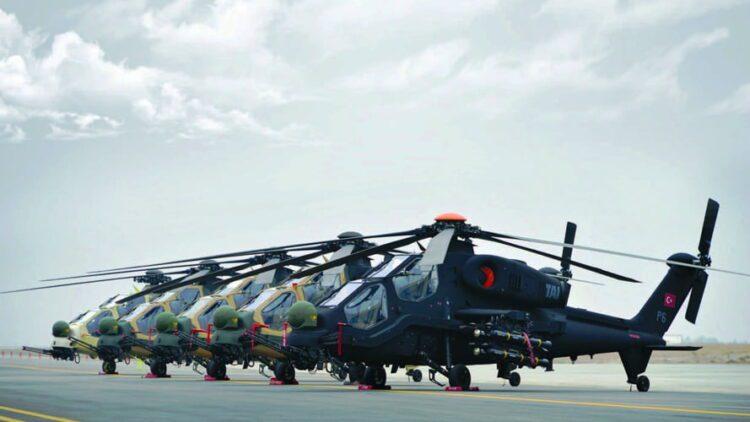
Bangladesh has reportedly approved the procurement of six Turkish-built T129 ATAK attack helicopters under a government-to-government agreement valued at around $600 million, a move that would significantly enhance the country’s rotary-wing combat capabilities. The deal, once finalized, would mark Bangladesh’s first acquisition of a dedicated attack helicopter platform.
The development was confirmed by Bangladesh Air Force (BAF) officials following a visit by Turkish Aerospace Industries (TAI) Director of Flight Testing Arif Ates to Dhaka earlier this month. During the visit, Ates met with Lieutenant General S.M. Kamrul Hassan, Principal Staff Officer of the Armed Forces Division, at Dhaka Cantonment on January 13. Lt Gen Hassan described the planned acquisition as a “major step forward” in strengthening Bangladesh’s combat aviation capabilities.
If the deal proceeds as expected, Bangladesh would become the fourth export customer of the T129 ATAK after Nigeria, the Philippines and Somalia. According to the Türkiye Today report, the helicopters could be delivered by 2027, subject to contract finalization, production timelines and the completion of pilot and maintenance training programs.
The induction of the T129 ATAK would represent a qualitative leap for the Bangladesh Air Force. Until now, the BAF’s combat helicopter role has been limited largely to Russian-made Mi-17 utility helicopters armed with unguided rockets or machine guns mounted on external pylons. In contrast, the T129 is a purpose-built attack helicopter designed for close air support, armed reconnaissance and anti-armor missions.
Based on the Italian Agusta A129 Mangusta platform, the T129 ATAK is powered by two CTS800 turboshaft engines generating a combined 2,746 shaft horsepower, with a maximum takeoff weight of around five tonnes. Its high power-to-weight ratio is considered particularly suitable for operations in hot and humid environments such as Bangladesh, where performance margins are critical.
The helicopter is equipped with advanced Turkish-developed avionics and sensors from Aselsan, while its weapons suite is largely supplied by Roketsan. Armament options include a nose-mounted 20 mm triple-barrel rotary cannon, Cirit 70 mm laser-guided rockets, unguided 70 mm rockets, and UMTAS/L-UMTAS anti-tank guided missiles. Future upgrades are expected to include integration of extended-range UMTAS variants capable of engaging targets at distances of up to 20 kilometers.
In addition, the T129 features the ASELFLIR-410 electro-optical/infrared targeting system and a comprehensive self-protection suite incorporating missile warning systems and electronic countermeasures. A senior Bangladesh Air Force spokesperson said the platform would provide “agile, all-weather strike capability,” significantly expanding the military’s operational options.
If completed, the acquisition would underscore Bangladesh’s growing defense cooperation with Türkiye and signal a shift toward more modern, specialized combat aviation assets within the country’s armed forces.
BOB Post