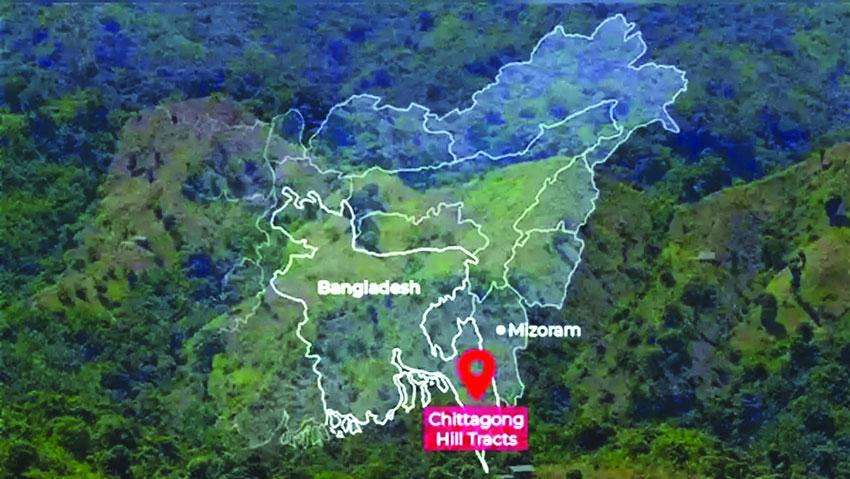
Nearly twenty-eight years have passed since the signing of the Chittagong Hill Tracts (CHT) Peace Accord. Time may have blurred many details in the pages of history, but the soil of the hills still soaks in blood. Where there was once hope for peace, today the region remains plagued by power struggles, abductions, extortion, and the terror of ransom-driven crimes.
The United People’s Democratic Front (UPDF), led by Prasit Bikash Khisa, stands as one of the starkest examples of this divide. On December 2, 1997, when dreams of stability were being woven across the hills, Prasit Khisa rejected the accord and launched a new armed resistance under the banner of a black flag. This resistance took formal shape on December 26, 1998, with the announcement of the UPDF at Dhaka University.

Though the UPDF branded itself as a movement striving for an “independent Chittagong Hill Tracts,” its actions quickly became synonymous with kidnapping, ransom collection, extortion, and violent turf wars. From the abduction of three Danish development officials to the recent kidnapping of five students from the University of Chittagong in Khagrachhari, the UPDF (Prasit faction) repeatedly appears at the center of such crimes. The Parbatya Chattagram Jana Samhati Samiti – PCJSS (Santu) – has also been implicated in several violent incidents.
Today, more than six armed groups operate in the hills: PCJSS (Santu), PCJSS (MN), UPDF (Prasit), UPDF (Democratic), the Mogh Party, and the Kuki-Chin National Front. The first four dominate in Khagrachhari, while the latter two are more active in Rangamati and Bandarban. In their pursuit of dominance, all these groups have inflicted unbearable suffering on ordinary residents. Killings, abductions, and ransom extortion have become part of daily life. Nearly 1.8 million people are effectively trapped by these armed factions.
Before the accord, the insurgency led by Shantu Larma’s Shanti Bahini claimed the lives of nearly thirty thousand Bengalis, security personnel, and indigenous hill residents. The accord was meant to end this cycle of violence. Instead, divisions deepened, new groups emerged, and competition for dominance turned the region into a battlefield yet again.
The recent abduction of the Chittagong University students by the UPDF (Prasit) exposed once more the group’s true motives far from championing the rights of hill communities, it has devolved into a force seeking extortion-based control. The swift and strategic operation by the Bangladesh Army successfully rescued the victims, but the underlying threats remain.
The peace accord envisioned a new dawn for the CHT, with disarmament and a return to democratic politics as the foundation for stability. But the armed groups ignored these commitments, embracing the path of violence to maintain control. Their internal rivalries have pushed the entire region into renewed conflict.
This raises a fundamental question: who benefits from this unrest? Certainly not the hill residents. Their dream was simple security, basic rights, and development. Yet some leaders have exploited these aspirations to serve their own interests. Genuine political demands for autonomy and rights have faded, replaced by extortion, violence, and criminal influence.
Government and security forces conduct operations from time to time, but a lasting solution remains elusive. This crisis is not merely a law-and-order issue; it is deeply political. Sustainable peace requires full implementation of the accord alongside decisive action against armed groups.
Restoring trust among the local population is essential. Development initiatives must accelerate, and both hill and Bengali communities must be ensured equal opportunities. One truth must remain central: rights cannot be achieved through the barrel of a gun. They come through justice, development, and peace.
The people of the CHT want no more bloodshed. They want education, healthcare, and employment. They want security, dignity, and a humane life. After 28 years of experience, the lesson is clear—there is no alternative to dialogue and compromise. And those who continue to hold the hills hostage with weapons must be met with united resistance.
For peace, for development, and for the restoration of normal life in the CHT, ending the cycle of terror is not just important, it is urgent.
BOB Post