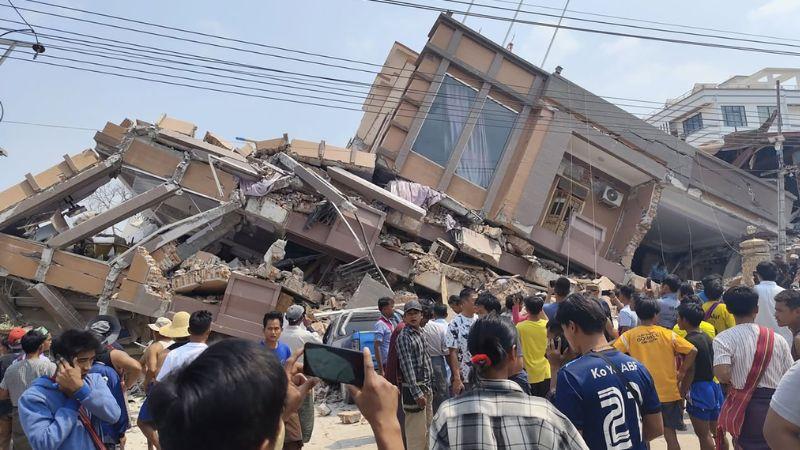
A catastrophic 7.7-magnitude earthquake struck central Myanmar on Friday(March 28), sending shockwaves across Thailand, China, India, Vietnam, and Bangladesh. The quake, which hit at 12:50 PM local time, originated near the city of Sagaing at depths ranging from 10 to 30 kilometers, according to the United States Geological Survey (USGS).
At least 23 people have been confirmed dead so far, with Myanmar declaring a state of emergency and appealing for international aid. Early reports indicate that 20 casualties occurred at a hospital in Naypyidaw, which is now being labeled as a potential “mass casualty area.” Additionally, a mosque in Mandalay collapsed during Friday prayers, leading to multiple fatalities, while a fire broke out at a university, causing further devastation.
The earthquake also triggered widespread panic in neighboring Thailand, where a 30-story building in Bangkok’s Chatuchak district collapsed, trapping 84 people. Thai authorities have confirmed three deaths from the incident. China’s Yunnan province, Kolkata in India, and major cities in Bangladesh, including Dhaka and Chattogram, also felt the tremors, though no casualties have been reported outside Myanmar and Thailand so far.
This earthquake is a stark reminder of the fragile infrastructure and unpreparedness in the region. Myanmar, already struggling with political instability and economic distress under its military junta, now faces a humanitarian disaster with crumbling infrastructure and limited emergency response capabilities.
Thailand, despite its stronger infrastructure, saw significant damage in its capital, with the government forced to declare an emergency. The collapse of high-rise buildings, particularly an under-construction skyscraper, raises questions about safety standards in urban development projects.
The increasing frequency and intensity of seismic events in the region could indicate a deeper crisis on the horizon. Scientists have long warned that tectonic movements are being influenced by climate change-related factors, including glacial melting and rising sea levels. The Sagaing Fault, which runs through Myanmar, has historically been active, but as tectonic plates shift unpredictably, Southeast Asia remains at severe risk of future quakes and aftershocks.
Leaders across the world have expressed condolences and offered aid, including Indian Prime Minister Narendra Modi, who assured immediate assistance. However, emergency responses are often reactionary rather than proactive. Governments in earthquake-prone regions must move beyond offering prayers and instead invest in resilient infrastructure, early warning systems, and rapid-response measures.
The reality is grim: natural disasters are becoming more frequent, and many developing nations remain unprepared. This earthquake should serve as a wake-up call. Without drastic action, the next disaster will not just shake buildings—it will shake the very foundation of these nations’ futures.
BOB Post