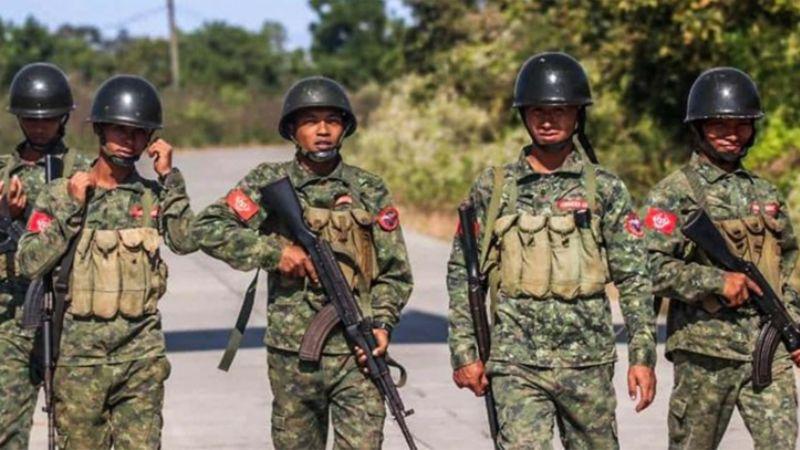
Security experts, former diplomats, and academics have called for strategic engagement with the Arakan Army (AA), which now controls over 80 percent of Myanmar’s Rakhine State, including the critical 271-km border with Bangladesh.
The issue was discussed at a policy dialogue titled "Rakhine after the Fall of Maungdaw: Implications for Bangladesh and the Region," organized by the Bangladesh Institute of Peace and Security Studies (BIPSS) at a city hotel. The session was moderated by BIPSS President Major General (retd) A N M Muniruzzaman and featured panelists Major General (retd) Md Shahidul Haque, a former Defense Attaché to Myanmar and former Ambassador to Libya, and Parvez Karim Abbasi, an assistant professor at East-West University.
Assistant Professor Abbasi emphasized the importance of initiating contact with the Arakan Army. "Engaging diplomatically with the Arakan Army is crucial, as such approaches are standard in many cases. At the same time, we should keep military options open," he said. He also suggested exploring informal channels for communication if direct engagement with the non-state actor proves challenging.
Abbasi warned that the Arakan Army’s control over Rakhine could escalate insurgency risks in India’s northeastern states, highlighting the broader regional implications.
Major General (retd) Muniruzzaman underscored the need for a clear strategy to navigate the complex situation in Rakhine. "If we fail to establish timely contact with the Arakan Army, the region's dynamics could shift further. Rakhine is not landlocked, and external connections are already being fostered through maritime routes," he cautioned.
Citing India's evolving approach, Muniruzzaman noted that New Delhi, historically aligned with Myanmar's junta, appears to be recalibrating its stance to engage with the Arakan Army, reflecting the changing realities in Rakhine.
Major General (retd) Haque described engagement with the Arakan Army as a "win-win situation" for Bangladesh, potentially bolstering both security and economic interests. He highlighted the strategic opportunity for Dhaka, especially in leveraging its position in negotiations with India. "For the first time, we have a chance to be in the driver’s seat regarding regional interests," he remarked.
However, Bangladesh's official stance remains cautious. Foreign Adviser Touhid Hossain recently reiterated Dhaka's reluctance to engage with non-state actors like the Arakan Army. Speaking after an informal consultation on Myanmar in Thailand, he emphasized that the responsibility lies with Myanmar to address border and Rakhine-related issues. "The border is no longer under Myanmar’s control; it is under non-state actors like the Arakan Army. As a state, we cannot engage with them. Myanmar must resolve these issues," he told reporters.
The Arakan Army’s growing dominance in Rakhine has raised concerns in Bangladesh over border security and the potential for a new influx of displaced Rohingyas. Experts at the dialogue urged proactive measures to address the emerging challenges and opportunities in this evolving regional landscape.
BOB Post