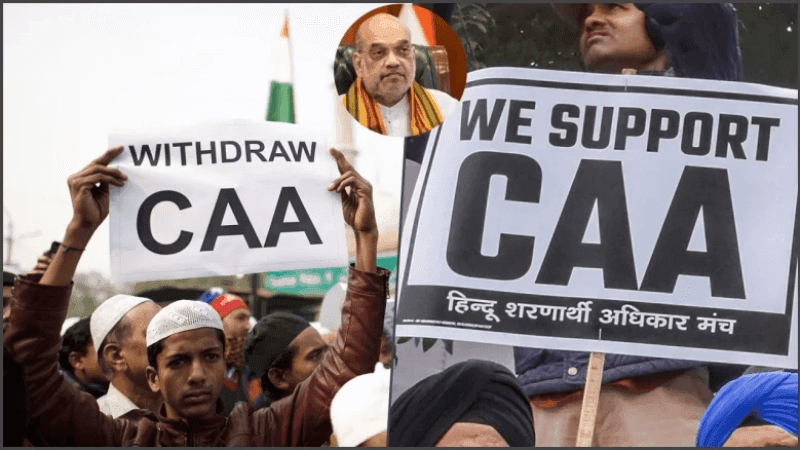
The Lok Sabha election verdict in India was announced on Saturday (March). Before that, on March 11, the central government issued a notice to effectively implement the Citizenship Amendment Act (CAA), which was passed four years ago. The opposition parties of the BJP (ruling party), immediately expressed their protest, claiming that the CAA is being implemented to increase the vote bank through religious polarization before the elections. Left-ruled Kerala has challenged the validity of this law. West Bengal Chief Minister Mamata Banerjee has criticized the Modi government's "deception" and "intimidation" regarding this law before the elections, leaving the United States concerned. The spokesperson for the US State Department, Matthew Miller, said on Thursday (March 14), "We are concerned about the notice issued by the Indian government on March 11 regarding the CAA. We are monitoring how this law is being implemented."
In the 2019 election manifesto, the BJP promised the implementation of the CAA. Amending the Citizenship Act of 1955, the bill was passed in 2019. In the same year, after the President's approval on December 12, the CAA bill was transformed into law. This led to widespread protests across India, starting from the capital Delhi and extending to other cities, with opposition to the CAA voiced not only by ordinary citizens but also by political parties. In over a hundred instances of conflict, government forces have been responsible for the loss of at least 50 protesters' lives. As the Lok Sabha elections approached in 2024, the BJP-led central government issued a "surprising" notice on Monday (March 11) to implement the controversial CAA law.
The Citizenship Act of 1955 explicitly mentioned that any person born in India or any person of Indian origin who resided in the country for a specified period would be granted citizenship. The law did not distinguish between Muslims and non-Muslims. In addition to that, it was stated in the old law that one must reside in India continuously for one year to obtain citizenship. Moreover, within the past 14 years, mandatory residence in India for 11 years was required. In the new law, the requirement has been reduced from 14 years to 11 years.
For a long time, there has been internal disagreement within the central government regarding the implementation of the CAA. The main objections to the CAA primarily arose from the northeastern states, mainly from Assam. Many fear that if the CAA is implemented, there will be a significant increase in the influx of refugees in the northeastern states, leading to evident linguistic and cultural issues. There is concern that Hindus from neighboring Bangladesh might migrate to India in large numbers to obtain Indian citizenship. Additionally, Bangladeshi immigrants residing in Assam (Bengali-speaking) may also seek pathways to citizenship. Alongside objections to the exclusion of Muslims from this law, there has also been a surge of protests. Additionally, the primary reason for opposition to the CAA in southern India is the exclusion of Tamil refugees.
The Citizenship Amendment Act (CAA) grants citizenship to minorities from Bangladesh, Pakistan, and Afghanistan, including Hindus, Buddhists, Jains, Sikhs, Parsis, and Christians, who seek refuge in India due to religious persecution. Eligibility for citizenship requires refugees to have sought refuge before December 31, 2014, and lived in India for five years. However, the law does not extend citizenship provisions to refugees from other communities or countries. Section 6 of the CAA, which grants citizenship to those who came to Assam before January 1, 1966, and up to March 25, 1971, has raised constitutional concerns, particularly among Assam residents.
Oppositions claim that the CAA contradicts the fundamental principles of the Indian Constitution. Through this law, "discrimination" has been created based on religion. The question arises as to why countries like Nepal, Sri Lanka, and Myanmar, where refugees also come from, are not mentioned in the law.
India has repeatedly declared that the CAA is an internal matter for them. The law explicitly mentions the names of three separate countries (Bangladesh, Afghanistan, and Pakistan). After labeling individuals from these countries as "victims of religious persecution." India must conduct a census to determine how many refugees it has granted citizenship to from each country. The country with the highest number of refugees will be closely scrutinized based on its religious and social structure. Therefore, the close relationship with these three countries, mentioned significantly in this law, is noteworthy.
Regardless of the situation in the other two countries, it is believed that Bangladesh will bear the brunt of the potential impact of the CAA. This is because India does not share any borders with Afghanistan, while there is constant tension along the India-Pakistan border. In this scenario, due to the CAA, the fear of Indian Muslims losing their citizenship and security is highest for entering Bangladesh through its borders. A report by the BBC has already highlighted incidents of infiltration into Bangladesh with the assistance of Indian border security forces.
Former Bangladeshi Foreign Minister AK Abdul Momen stated in India several months after the passage of the law that if any instability arises in India, Bangladesh, as a neighboring country, would be affected by its repercussions. However, he also acknowledged that it is an internal matter of India, indicating his awareness of the sensitivity surrounding India's internal affairs.
After maintaining silence for a long time, during a visit to the United Arab Emirates in 2020, Bangladeshi Prime Minister Sheikh Hasina remarked to the media, "We could not understand why the Indian government did this (CAA). There was no need for it." However, she also reminded everyone of the notion of India's "internal matter." Bangladesh's current Foreign Minister, Dr. Hasan Mahmud, has also referred to the matter as India's "internal issue."
Before the passage of the Citizenship Amendment Bill, Sheikh Hasina had conveyed her concerns to Modi regarding the National Register of Citizens (NRC). During the General Assembly of the United Nations, the two leaders had discussions on this issue. At that time, Hasina told Modi that the NRC was a matter of "deep concern" for them as neighboring countries. However, Modi assured at the time that there was no reason for concern as the two countries maintain a good relationship.
In the entire South Asian region, India has been somewhat tolerant towards hosting refugees. Refugees from Tibet, Tamils from Sri Lanka, Chakmas and Rohingyas from Bangladesh and Myanmar, as well as Muslims from Afghanistan, and Hindus, Jains, Sikhs, and Christians at various times have sought refuge in India. Decade after decade, India has provided them shelter. And India has stated that it will not deviate from its policy of providing shelter to oppressed minorities.
However, if in the process it gives additional benefits to any particular religion preferred by the powerless instead of following a policy of religious neutrality, it could create complexity in relations with neighboring countries and undermine the secular character of the constitution. Especially in India, this law is criticized as a reflection of anti-Muslim sentiment and exacerbating political conflicts and tensions over temples and mosques
BOB Post