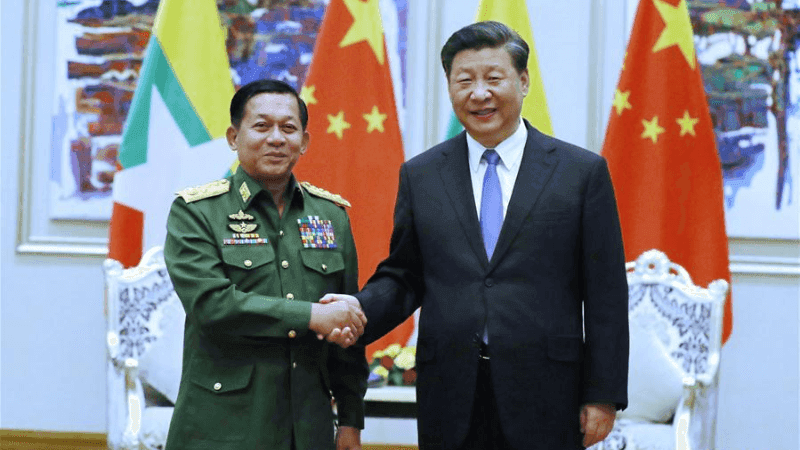
In a significant development, the Myanmar junta and Chinese state-owned firm CITIC have inked an addendum to the concession agreement for the Kyaukphyu Special Economic Zone (SEZ) and deep-sea port. The signing ceremony, held in Naypyitaw, included top junta officials, diplomats from the Chinese Embassy, and CITIC executives, underlining the importance of the project for both sides.
The Kyaukphyu SEZ Deep Seaport Co. Ltd, a joint venture between CITIC Myanmar Port Investment Limited and the Myanmar government-backed Kyaukphyu SEZ Management Committee, is responsible for the project. The undisclosed details of the addendum suggest possible concessions made by the junta to ensure the project's progression, according to business analysts.
The project's shareholding structure remains unaltered, with CITIC holding a 70 percent stake and the Myanmar side holding 30 percent, as agreed upon in 2018. The Kyaukphyu port and SEZ play a pivotal role in the 1,700-kilometer China-Myanmar Economic Corridor, connecting Yunnan province to the Indian Ocean.

While the budgets for the SEZ and port stand at $1.3 billion and $7.3 billion, respectively, the total area will span 150 hectares on Maday Island and 96 hectares on Ramree Island in Rakhine’s Kyaukphyu Township.
The signing of the addendum coincides with the junta's urgent need for support amid losses from an offensive along the China border by the Brotherhood Alliance. China's influence over ethnic armed groups near its border positions it as a critical ally for the junta in this challenging time.
The Kyaukphyu SEZ and deep-sea port are integral to the China-Myanmar Economic Corridor, providing China with direct access to the Indian Ocean and offering an alternative route for its oil imports.
Despite the junta's push for the project's prompt resumption, local protests and ongoing conflicts in the region pose challenges. The project's completion is envisioned as a vital trade hub connecting Asia, Africa, and Europe, fostering socio-economic development in Myanmar and the broader region.
Aung Naing Oo, junta Government Office Minister, and Liang Chuanxin, CITIC group chair, expressed optimism about the collaboration, emphasizing the project's potential to become a gateway to the world. However, local residents, concerned about the environmental impact on their fisheries, and ongoing conflicts in Ramree, remain sources of contention for the massive infrastructure endeavor.
BOB Post