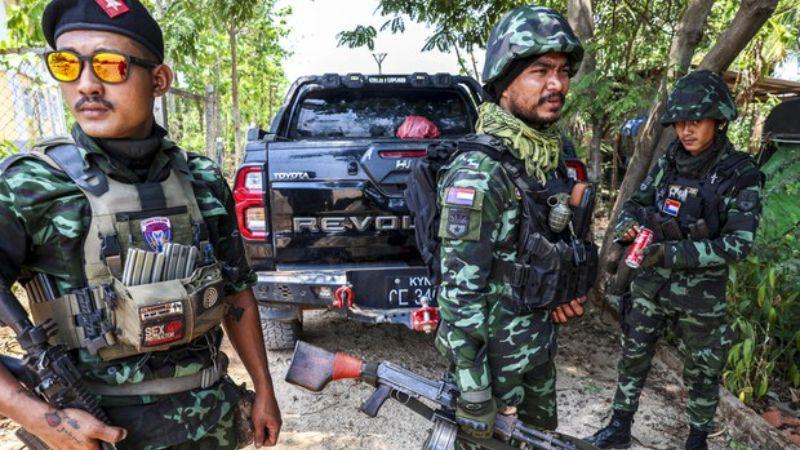
As the tumultuous clock ticks past three years since Myanmar's military seized control in the infamous coup d'état of February 2021, the junta's once ironclad grip on power now slips amidst the chaos of a nationwide civil war.
What began as a strategic maneuver to tighten control over Myanmar's distant borderlands has transformed into a desperate struggle for survival for the armed forces, Battling with a relentless and increasingly unified coalition of rebel factions. The junta's troops find themselves staggering under the weight of successive battlefield losses.
Experts versed in Myanmar's political landscape paint a bleak picture of the military regime's prospects, suggesting that the specter of defeat looms larger than ever on the horizon. Zachary Abuza, a seasoned Southeast Asia analyst from the halls of the National War College in Washington, delivered a scathing assessment, accusing Myanmar's military leadership of stubbornly ignoring the harsh realities plaguing their nation.
The economic backbone has already crumbled, according to Abuza, whose penetrating analyses grace the pages of Radio Free Asia and BenarNews. Battles lost, urban centers engulfed in escalating violence, and once impregnable bastions breached by relentless drone strikes. The generals find themselves ensnared in a web of challenges, besieged by unrelenting pressure from the shadowy National Unity Government (NUG) and its allies.
Across the country, the junta's military forces suffer losses to rebel factions, notably in Myanmar's Kachin, Rakhine, and Kayin states. Troop shortages reach critical levels. A highly unpopular military draft also failed to bolster their ranks, as reported by observers speaking to RFA Burmese.
In Rakhine state, the ethnic Arakan Army (AA) has seized control of numerous townships, including one in Chin state, since terminating a ceasefire with the military in November 2023. The junta's desperation is visible by its forced recruitment of long marginalized Rohingyas, in Myanmar, to reinforce its ranks against the insurgents.
Retired U.S. Army Lieutenant Colonel Miemie Winn Byrd, deeply involved in Myanmar affairs, views the situation in Rakhine as a sign of the junta's vulnerability. In the coming months, any setback for the military will be challenging to overcome, she told RFA Burmese. The conscription law's passage shows us a glaring reality: The Junta’s ranks are thinning.
Jason Tower, U.S. Institute of Peace's country director for Myanmar, stated concerns about the junta's precarious position due to troop shortages. The number of soldiers lost far exceeds the replenishment from the conscription law, as per his observation. New recruits, forced into battle, are more likely to surrender or desert upon reaching the front lines, he thinks.
In Kayin state, the town of Myawaddy becomes a focal point in the struggle. Vital for trade flowing across the border with Thailand's Mae Sot, control of Myawaddy becomes a flashpoint between joint anti-junta forces led by the ethnic Karen National Liberation Army (KNLA) and the military.
The KNLA and its allies seize the junta's Infantry Battalion 275 compound in downtown Myawaddy on April 10, dealing a significant blow to the junta's presence. Yet, recent developments indicate a seesaw battle, with the military reclaiming some territory while the KNLA retains control of strategic locations in the wider Myawaddy township.
Ethnic armies, like the KNLA, increasingly collaborate with guerillas forming the People's Defense Force (PDF), a loose coalition pledging allegiance to Myanmar's shadow NUG. Ethnic ceasefires waver as the conflict drags on, with movements toward the rebellion signaling a tipping point.
Sai Kyi Zin Soe, a military and political commentator, notes the strategic focus of anti-junta forces on border areas to control trade routes. Cooperation among diverse groups is pivotal, with vigilance and mutual control defining the conflict's intricate dynamics.
In Kachin state, the Kachin Independence Army (KIA) launches an offensive against the military, capturing over 60 military camps in a month-long campaign. The KIA's control extends to key trade routes along the border with China, demonstrating the rebellion's expanding reach.
The Three Brotherhood Alliance in Shan state secures victories, capturing towns and villages since October in their offensive against the junta. Byrd lauds the alliance's joint operations and intelligence gathering, notably the effective use of drones to counter military airstrikes.
The conflict spreads to Kayah state, where the Karenni Army and allies seize several townships, including Mese on the Thai border. Administrative structures and measures to promote law and order reflect a shift toward governance amidst the chaos of conflict.
In Sagaing region, PDF clashes with the military underscore internal strife among anti-junta forces, hindering a united front against the military. Despite military control in central Myanmar regions, questions arise over the junta's ability to lead amidst mounting failures.
Retired military officers criticizes junta's poor leadership, strategic flaws, and mismanagement causing battlefield setbacks and critical issues. As the junta's grip on power weakens, Abuza warns of the unintended consequences of senseless actions amid turmoil, emphasizing the chaos as a significant victory for the rebellion.
BOB Post