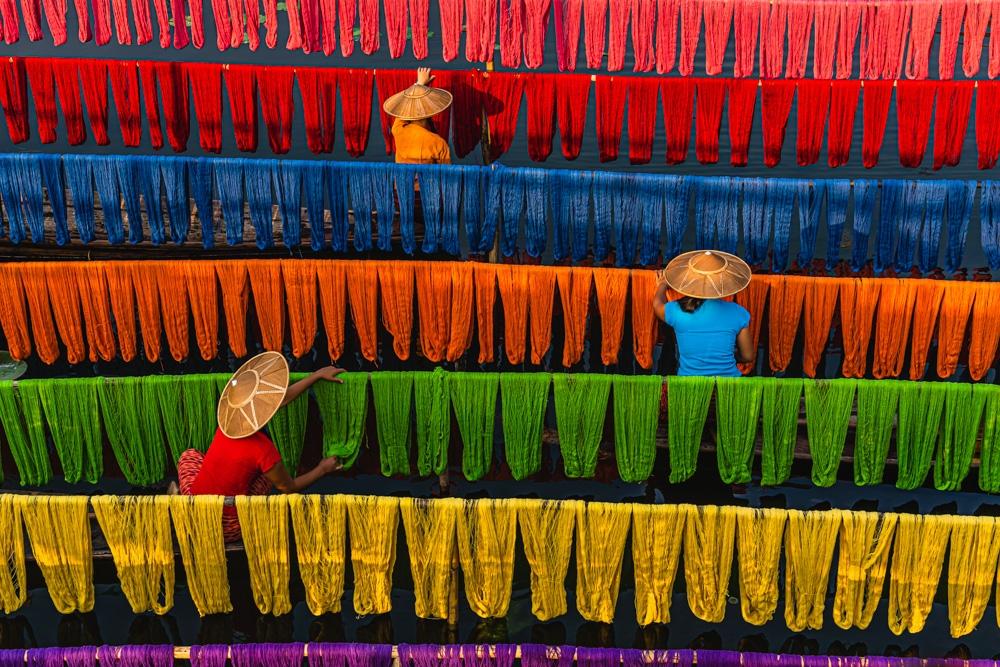
In the heart of Myanmar's southern Shan state lies the serene and expansive Inle Lake. This unique aquatic world is the ancestral home of the Intha people, a community that lives almost entirely on the water. In their iconic stilt houses, surrounded by floating gardens, the "sons of the lake" have built a life in harmony with their environment.
Among their many traditions, one is almost unknown to the outside world yet represents the pinnacle of their cultural skill: the ancient and painstaking art of weaving textiles from the fibers of the lotus flower.
This is not a simple process. It is a cultural skill passed from one generation to the next, demanding a level of dedication that is hard to find.

At the Inle Treasure Hand Weaving Centre, the journey from plant to product begins with a single, careful snap. A young Intha woman takes a freshly cut lotus stem, breaks it, and slowly pulls the ends apart. As she does, she reveals the gossamer-thin, sticky fibers within, which she deftly gathers and rolls together.
"Extracting lotus fibers is labor-intensive," explained Ye Yint Phyo, a marketing representative for the center. "It requires specific skills, patience, and time."
The sheer scale of the work is staggering. "To produce a small scarf, we use fibers from about 7,000 stems," Ye Yint Phyo noted. This painstaking extraction process is why the resulting fabric costs about seven times more than ordinary textiles.
Once gathered, the naturally creamy threads are spun on a hand-turned wheel. They are then dyed using only natural materials-tree bark, seeds, jackfruit, and even lotus leaves which imbue the threads with soft, earthy tones. Finally, the prepared spools are taken to traditional handlooms, where artisans weave the fragile strands into exquisite scarves, robes, and shirts.
For those who practice it, this craft is more than a livelihood; it is a vital piece of their identity.
"Lotus fiber originated in Myanmar and is produced only in Inle. It's part of our identity," said Daw Myat Su Su Nge, the owner of the Inle Treasure Hand Weaving Centre.
The final textile is prized for its unique, almost magical properties. "The beauty of lotus fibers is that it keeps you cool in summer and warm in winter," she added.
This living heritage is embodied by artisans like 71-year-old Daw Mya Lay. Her weathered hands move with a gentle, practiced grace as she works the loom at the Khit Sunn Yin Weaving Centre.
"Extracting and weaving lotus fibers must be done slowly and carefully," she said softly. "It takes patience and time."
This profound skill, however, is fragile. "There are only a few people who know how to extract and weave lotus fibers properly," Daw Myat Su Su Nge lamented. "Skilled lotus weavers are limited, so we also train young people to keep the tradition alive."
The pandemic also dealt a blow to the weavers, who relied heavily on international visitors. "Before COVID-19, sales were better," said Ma Chaw Su Aye, owner of the Myint Myat Thway Weaving Centre. "We hope more people come to see our work."
Inside the lakeside workshops, the steady, rhythmic clack of the looms continues. It’s an echo across the water the sound of patient hands transforming a humble lake flower into a thread of cultural survival.
BOB Post