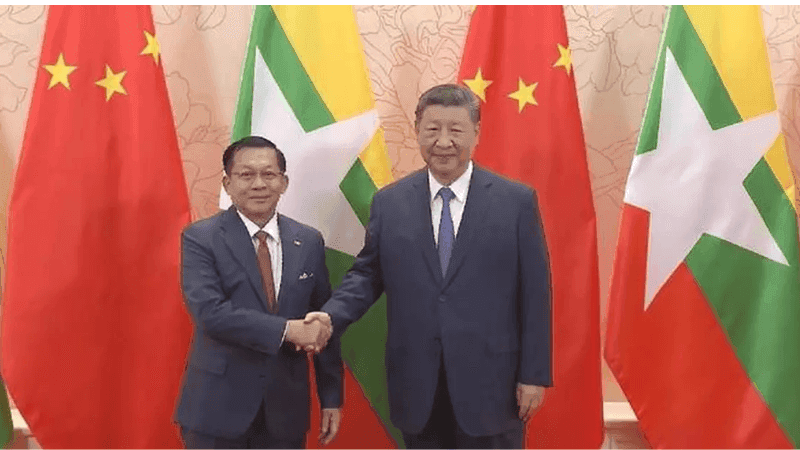
Myanmar’s junta leader Min Aung Hlaing has publicly expressed gratitude to Chinese President Xi Jinping for Beijing’s role in pressuring anti-regime ethnic armed groups in northern Myanmar, underscoring China’s deepening influence over the country’s conflict and politics.
In a video released by pro-regime media during his official visit to China, Min Aung Hlaing said he was thankful for China’s efforts, which he claimed had contributed to “peaceful conditions” in northern Myanmar. The remark, however, was absent from official statements issued by both Beijing and the junta.
The meeting with Xi took place on August 30 at the Tianjin Guest House, during Min Aung Hlaing’s visit to China for the Shanghai Cooperation Organization (SCO) summit. His latest trip comes at the personal invitation of Xi and follows a series of diplomatic engagements since late 2024, when Beijing began openly backing the military regime after a string of battlefield defeats against ethnic armed forces.

During Operation 1027 in 2023–2024, the junta lost vast territories in northern Shan State, including Lashio, to ethnic forces. China subsequently pressured groups such as the Myanmar National Democratic Alliance Army (MNDAA) and Ta’ang National Liberation Army (TNLA) to halt offensives and relinquish captured areas. Beijing’s influence also forced the United Wa State Army the most powerful ethnic armed group in Myanmar to cut back support for its allies.
Analysts say Min Aung Hlaing’s rare public acknowledgment of Beijing’s role confirms that China has been actively shaping the military balance in northern Myanmar, despite its official position as a neutral mediator.
Beyond conflict mediation, China’s broader interests in Myanmar remain strategic and economic. Beijing views Myanmar as vital for advancing its Belt and Road Initiative (BRI) and the China-Myanmar Economic Corridor (CMEC), which provide direct access to the Indian Ocean and safeguard China’s energy and trade routes. Myanmar also holds significant rare earth deposits critical to China’s high-tech .

At the Tianjin meeting, both leaders discussed accelerating BRI and CMEC projects, border stability, and Beijing’s backing for Myanmar’s planned election in December. Xi reiterated China’s opposition to foreign interference in Myanmar’s politics, while Min Aung Hlaing reaffirmed his commitment to the One China policy.
Seven memoranda of understanding were signed, covering customs cooperation, small and medium enterprises, and information exchange. Min Aung Hlaing also urged Chinese businesses to invest in sectors such as energy, infrastructure, mining, and electric vehicles.
On the sidelines of the SCO summit, Min Aung Hlaing met Indian Prime Minister Narendra Modi, with both leaders agreeing to deepen ties in trade, connectivity, and resource development an indication that Myanmar remains a critical arena where regional powers are competing for influence.
BOB Post