Myanmar’s military-appointed Union Election Commission (UEC) has announced plans to hold elections in 267 of the country’s 330 townships in December 2025 or January 2026—contingent on the prevailing security situation.
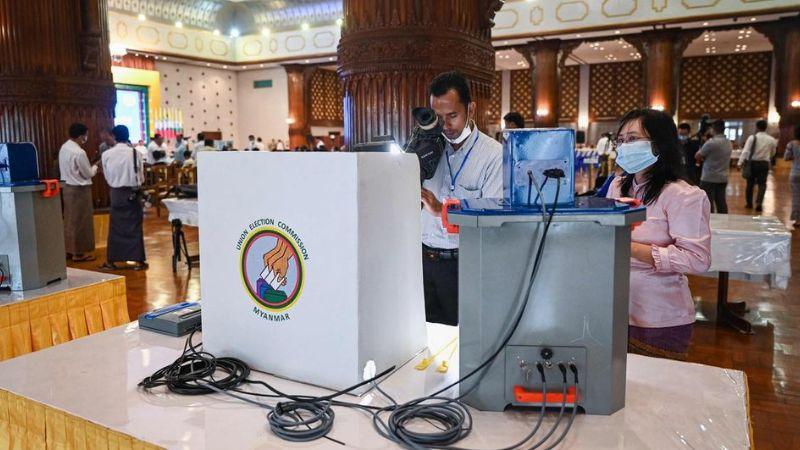
The UEC, speaking to CNI Burmese, said the upcoming vote would use a combination of the first-past-the-post and proportional representation systems. The junta also plans to introduce electronic voting for the first time.
However, the election schedule remains uncertain, with the commission indicating that actual polling dates could vary depending on conflict conditions in different regions.
According to the civilian National Unity Government (NUG), which operates in opposition to the military regime, approximately 144 townships are currently under the control of anti-regime forces, and 79 townships are witnessing active armed conflict.
Junta leader Senior General Min Aung Hlaing, who seized power in a February 2021 coup, has repeatedly promised elections as part of his “roadmap to democracy,” but has yet to confirm an exact date. His administration has claimed support from international allies, including China and Russia, while Western nations and the NUG have dismissed the planned polls as illegitimate.
Critics view the election as a strategic move to lend legitimacy to continued military rule. The National League for Democracy (NLD), which won the last general election in 2020 by a landslide, has been dissolved after refusing to register under the junta’s authority. Its leader, Daw Aung San Suu Kyi, remains imprisoned along with several senior party members.
The previously influential Shan National League for Democracy was also dissolved in a similar fashion.
Of the 54 political parties approved to contest, only a handful are competing nationwide—primarily those aligned with or seen as sympathetic to the military regime, such as the Union Solidarity and Development Party, the National Unity Party, and the People’s Pioneer Party.
As the military moves forward with its electoral plans, international concern continues to mount. Malaysia, chairing the Association of Southeast Asian Nations (ASEAN) this year, has called on the junta to cease hostilities and prioritize dialogue over elections. The group has struggled to implement its Five-Point Consensus on Myanmar, which calls for an end to violence and inclusive political dialogue.
The NUG, ethnic resistance organizations, and civil society groups inside Myanmar maintain that any election conducted under military rule cannot be free, fair, or credible.
BOB Post