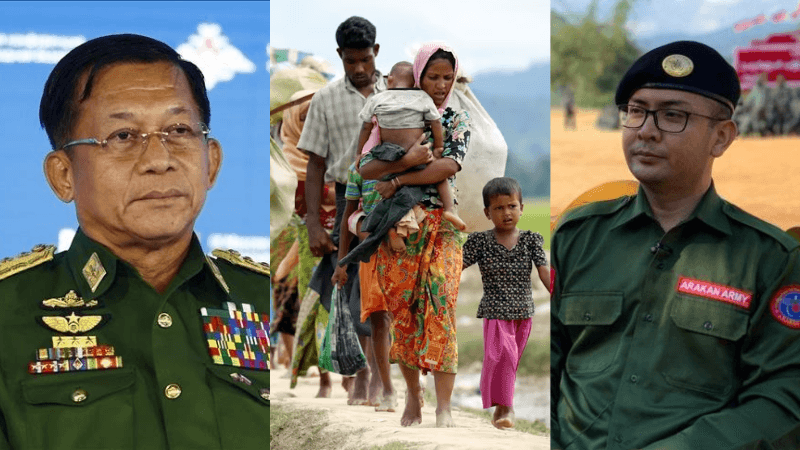
Amid relentless monsoon rains and mounting humanitarian needs, the Arakan Army (AA) has reportedly ordered the forced relocation of Rohingya civilians in at least six villages in northern Maungdaw Township, sparking fears of renewed mass displacement and ethnic persecution in western Myanmar.
Local sources and independent reports, including those from the Development Media Group, confirm that the AA has issued directives instructing Rohingya families to vacate their homes and farmland “for security reasons.” However, affected residents say the move has provoked widespread fear and confusion, particularly given the lack of alternative shelter and the extreme weather conditions.
“We’ve been told to leave immediately,” said one resident from the Aung Bala (Pan Zin) area. “But where do we go? The roads are flooded, the camps are full, and we have no means to survive elsewhere.”

The villages currently under threat include:Aung Bala (Pan Zin),Sin Thay Pyin,Nga Khu Ya,Laung Don,Hpar Wut Chaung',Mingalar Nyunt.
These communities, mostly inhabited by internally displaced Rohingya who never received official resettlement are being targeted at a time when movement is severely restricted by landslides, washed-out roads, and monsoon flooding.
A Growing Humanitarian Emergency
“This is not a mere relocation; it’s a potential humanitarian disaster unfolding in real-time,” said a Rohingya humanitarian worker in Maungdaw, speaking on condition of anonymity due to security risks.
International aid agencies have echoed these concerns, warning that any large-scale displacement during the monsoon season could lead to severe food shortages, disease outbreaks, and loss of life—particularly among vulnerable populations such as children, the elderly, and pregnant women.The Arakan Army, an ethnic Rakhine armed group that has steadily expanded its territorial control in northern Rakhine State since renewed fighting with the Myanmar military, is now exercising de facto authority over large parts of the region. However, despite portraying itself as a resistance force against the military junta, the AA has frequently been accused of excluding and mistreating Rohingya civilians under its control.

Reports of forced labor, arbitrary restrictions on movement, and now mass eviction orders have raised alarm among rights groups that the AA may be replicating the same oppressive tactics historically employed by the Burmese military.
“We’ve already lost everything once when the military burned our villages,” said a village elder in Sin Thay Pyin. “Now the Arakan Army is driving us out again. We are tired of running—we just want to live in peace.”
Caught between the Myanmar junta, which continues to deny Rohingya citizenship and basic rights, and an armed Rakhine group that increasingly treats them as unwanted outsiders, Rohingya communities say they feel abandoned both locally and internationally.
Rohingya political analyst Ro Mayyu Islam, founder of the Rohingya Genocide Prevention Research Network (RGPRN), issued a stark warning: “The world must understand that this is not a ‘liberated zone’ for the Rohingya. Arakan is becoming a new front for silent ethnic cleansing under a different flag.”
Calls for Urgent International Intervention
Rohingya leaders, human rights defenders, and humanitarian agencies are calling on the international community, particularly the United Nations, ASEAN, and the International Committee of the Red Cross to act urgently and prevent further displacement. Their key demands include:
Immediate international monitoring and access to affected areas in northern Rakhine Emergency shelter, food, and health assistance to displaced and at-risk populations The inclusion of Rohingya voices in local governance, conflict resolution, and peacebuilding efforts Observers warn that failure to act could result in a repeat of past atrocities and a further entrenchment of statelessness, dispossession, and ethnic discrimination against the Rohingya. As monsoon waters rise and armed actors tighten their grip, thousands of Rohingya face the grim prospect of losing what little remains of their homes, livelihoods, and dignity-once again.
BOB Post