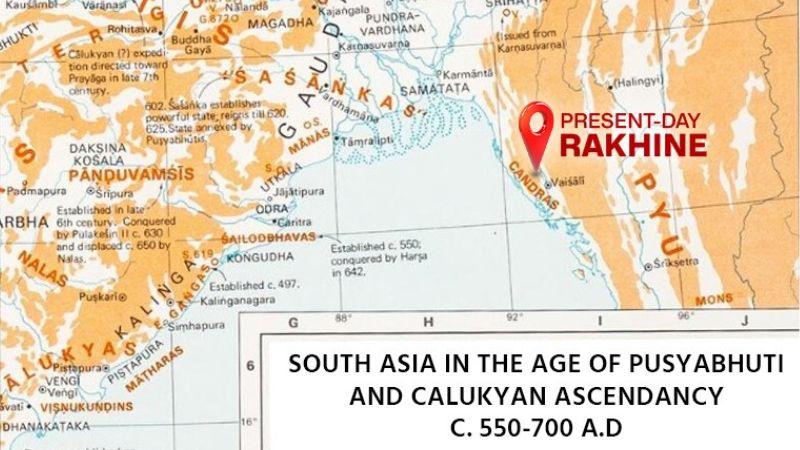
The origins of the Rohingya people remain difficult to trace with absolute certainty. The Rohingya claim indigenous roots in western Myanmar, tracing their heritage over a millennium with influences from Arabs, Mughals, and Portuguese. They assert descent from precolonial and colonial Arakan, historically an independent kingdom linking Southeast Asia and the Indian subcontinent. At that time, Arakan was an independent region, culturally distinct but deeply connected to the broader Indian subcontinent. The Rohingya identity was shaped over centuries through intermingling with Arabian traders, local Rakhine Buddhists, and neighbouring Bengali people of the Indian subcontinent, making them an inseparable part of Arakan’s history. This truth becomes clear when we consider the appearance, language, dress, food habits, and rituals of the Rohingya people.
Arakan’s strategic location along the Bay of Bengal made it a crucial hub for maritime trade and cultural exchange between Burma and the wider world, dating back to the time of the Indian Maurya Empire. According to political science scholar Syed Islam, Arab merchants had established contact with Arakan as early as the third century, using the Bay of Bengal as a trade route. A southern branch of the Silk Road also facilitated connections between India, Burma, and China since the Neolithic period. By the 9th century, Arab traders had settled in the coastal areas of southeast Bengal, bordering Arakan, and the Rohingya trace their ancestry to these early interactions. Syed Islam further notes that Muslim settlements in Arakan began as early as the 7th century, with Arab traders not only engaging in commerce but also spreading Islam. By 788 CE, local Buddhists had begun converting to Islam, and Arab merchants intermarried with the local population, gradually increasing the Muslim community in the region.
During British colonial rule, to expand the timber trade from Burma, British administrators brought a small number of Bengalis (estimated to be no more than three hundred) as immigrants from Chittagong to Arakan (present-day Rakhine) in Burma (now Myanmar), which was part of British India at the time. These migrants, brought in primarily as laborers, eventually assimilated into the existing Rohingya community.
Taking advantage of the migration of this small number of Bengalis, the Myanmar government has propagated the claim that the entire Rohingya community is Bengali or Bangladeshi. By spreading this propaganda, Myanmar has continued to expel the Rohingyas from their ancestral land. Despite their relatively small numbers, Myanmar has weaponized their presence as a historical justification to claim that all Rohingyas are Bengalis, not an ethnic community of Burma. This propaganda has led to decades of systemic discrimination, culminating in waves of violent persecution and forced expulsions of the Rohingya people. Several rounds of genocide and systemic repression have forced countless Rohingyas to flee their ancestral lands by sea, seeking refuge in neighbouring countries.
In response, Bangladesh opened its borders and provided sanctuary, while countries such as Indonesia, Malaysia, Thailand, and even Pakistan extended shelter to those in desperate need. Yet, a glaring paradox remains. Despite being Myanmar’s closest neighbour, India has taken a markedly different stance. Instead of embracing a humanitarian role, India has significantly tightened its border security so that the Rohingyas cannot enter India. Many Rohingyas who manage to evade the rigorous surveillance find themselves pushed into Bangladesh. Some Indian policymakers and leaders have even portrayed the Rohingyas as "original residents" of Chittagong, implicitly suggesting that the responsibility for their rescue falls solely on Bangladesh. This perspective is both historically and ethically flawed.
However, when the Rohingyas first settled in Arakan, neither Bangladesh nor India existed as sovereign entities. Chittagong was simply one of many regions within the vast Indian subcontinent. The British-era resettlement of Bengalis in Arakan did not make them Bangladeshis, as Bangladesh did not come into existence until 1971. These migrants were Indian subjects at the time. Therefore, the responsibility for the Rohingya people should not be placed solely on Bangladesh. It must be shared equally by all three successor states of British India: India, Pakistan, and Bangladesh.
Despite this historical reality, India has chosen a policy of exclusion. India has selectively embraced other refugees based on religious identity, exposing the deep contradictions in its humanitarian stance. By denying asylum to Rohingyas while welcoming others, India is not only failing in its moral duty but also violating international human rights principles.
In contrast, Bangladesh has shouldered an immense humanitarian burden by providing shelter to over a million displaced Rohingyas. The country, already densely populated and economically strained, has gone above and beyond to uphold the values of human dignity and protection. However, this generosity cannot be sustained indefinitely without meaningful international support and regional cooperation.
The time has come for India to recognize its historical ties to the Rohingya people and acknowledge its share of responsibility. Just as Pakistan has accepted a segment of Rohingya refugees, India must abandon its exclusionary stance and adopt a humanitarian approach. The Rohingya crisis is not Bangladesh’s burden alone; it is a legacy of the Indian subcontinent, and its resolution requires collective action from all its successor states.
Moving forward, a regional solution is the only sustainable way to ensure justice for the Rohingya people. A multilateral framework involving Bangladesh, India, and Pakistan—alongside international actors—must be established to share the responsibility of hosting, protecting, and ultimately repatriating the Rohingya people. Only by embracing history, rejecting narrow nationalistic narratives, and fostering regional cooperation we can hope to break the cycle of persecution and displacement.
The plight of the Rohingyas is a test of South Asia’s commitment to justice, human rights, and historical truth. It is not just Bangladesh’s duty to protect them; it is a responsibility that all three nations—India, Pakistan, and Bangladesh—must bear together. The Rohingyas are a part of the subcontinent’s shared past; now, they are victims of a contemporary political crisis. Their future should not be determined by exclusion but by a collective effort to ensure their safety, dignity, and rightful place in history.
Mamun Majumdar, Columnist