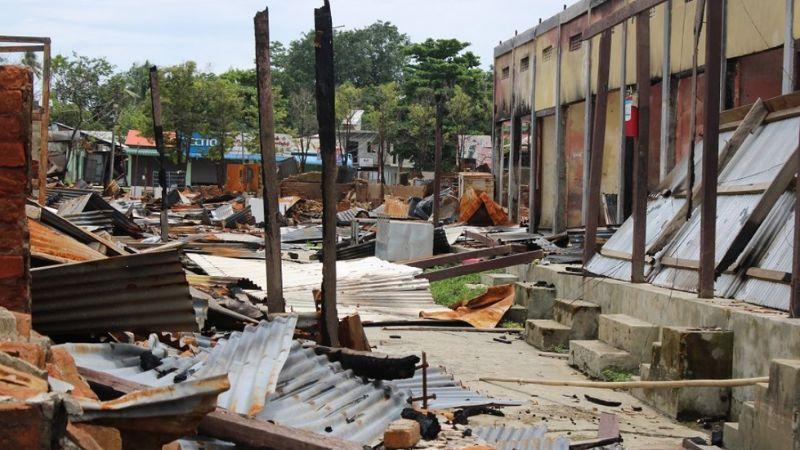
In May 2024, the town of Buthidaung in Myanmar’s Rakhine State witnessed significant human rights violations against Rohingya Muslims, following an offensive by the rebel group Arakan Army (AA) against the Myanmar military’s State Administration Council (SAC). These violations came to light as the Arakan Army launched its campaign to take control of Buthidaung in April. The U.S.-based magazine The Diplomat provided an on-the-ground report detailing the situation.
Buthidaung is a strategic town near Myanmar’s northwestern border. Allegations surfaced that on May 17, 2024, the Arakan Army instructed Rohingya Muslims to leave the town. Videos showing Rohingya men, women, and children fleeing circulated on social media, rekindling memories of the 2017 military crackdown that forced over 700,000 Rohingya refugees to flee to Bangladesh.

UN Reports and Allegations
A September 2024 report by the United Nations Office of the High Commissioner for Human Rights (OHCHR) accused both the SAC and the Arakan Army of committing violence against Rohingya and other civilians in Buthidaung. The report documented deliberate arson of homes and government buildings, shooting civilians, and committing acts of torture and sexual violence. Both the Myanmar military and the Arakan Army denied these allegations, but evidence showed homes were burned, and eyewitnesses claimed that dozens of civilians were killed during the conflict.

Background of the Conflict
Buthidaung is located 96 kilometers northwest of Rakhine's capital, Sittwe, and is part of the Maungdaw district. Around 70% of Buthidaung’s population, about 180,000 people, are Rohingya Muslims. The rest includes Rakhine Buddhists (25%) and other small ethnic groups such as the Khumi, Khamin, Mro, Chin, Daignet, and Bengali Hindus.
Before the fighting in Buthidaung, the Arakan Army had already captured large parts of southern Chin State and Rakhine State. As the Arakan Army advanced on Buthidaung, the Myanmar military realized they could not hold the town. Major Hlaing Win Tun, who was later captured, revealed that the military's defenses had weakened due to dwindling supplies, low morale, and a lack of public support.

Military’s Strategy and ARSA’s Collaboration
In response, the military formed a militia in collaboration with the Arakan Rohingya Salvation Army (ARSA) to defend Buthidaung and inflame communal tensions. Arakan Army leaders stated that the military also sought to cooperate with two other Rohingya militant groups—the Rohingya Solidarity Organization (RSO) and the Arakan Rohingya Army—but no significant activity from these groups was reported in Buthidaung.
According to the captured Major Hlaing Win Tun, the Myanmar military trained 750 Rohingya youths. In March and April, these youths were deployed to defend the town and were involved in burning Rakhine Buddhists’ homes.
Forced Recruitment of Rohingya Youth
Before the military's plan could fully unfold, several Rohingya youths defected from ARSA and surrendered to the Arakan Army. They revealed in interviews how they were forcibly recruited and coerced into criminal activities by the joint efforts of ARSA and the military.
One Rohingya youth, Hamidullah, shared, "We were forced to guard military posts, burn the homes of Rakhine Buddhists, and dig trenches to prepare for battle. ARSA members were with us, and some military officers closely monitored us."
Civilians Caught in the Violence
Civilians suffered greatly during the Arakan Army’s campaign. Thar Yar Aung, a member of the Khumi community in Buthidaung, recounted, "On April 19, a group of Muslim youths came to our ward, ordering us to vacate our homes. They looted our belongings and then set our houses on fire."
The UN report corroborated this, stating that in April 2024, homes belonging to both Rohingya and Rakhine communities in Buthidaung were set ablaze.

Who Burned the Rohingya Homes?
There are differing accounts regarding the burning of Rohingya homes in Buthidaung. According to the UN High Commissioner’s report, after the Arakan Army entered Buthidaung on May 17, they set fire to Rohingya homes and other buildings. In contrast, the Australian Strategic Policy Institute (ASPI) suggested that the military and Rohingya militants burned homes belonging to Buddhists and Hindus to stoke communal tensions.
The Arakan Army denied these accusations. Rohingya leader Abul Bashar claimed that the homes were destroyed by a joint operation between ARSA and the military.
The Situation Moving Forward
The tense situation in Buthidaung and the complex relationships between the different communities could have long-lasting effects on Myanmar’s political and social landscape. As the conflict deepens, many Rohingya believe that the Arakan Army might offer a new future for them. Rohingya teacher Abul Bashar stated, "The Arakan Army has assured us that they will guarantee equal rights for all communities."
BOB Post