The Arakan Army (AA) is tightening its grip on northern Rakhine State, collecting funds from Rohingya business owners while forcing impoverished villagers to perform unpaid labor on infrastructure projects. The armed group, which has grown in influence since intensifying clashes with the Myanmar military, is increasingly operating as an unchallenged autocratic power, imposing harsh conditions on local communities.
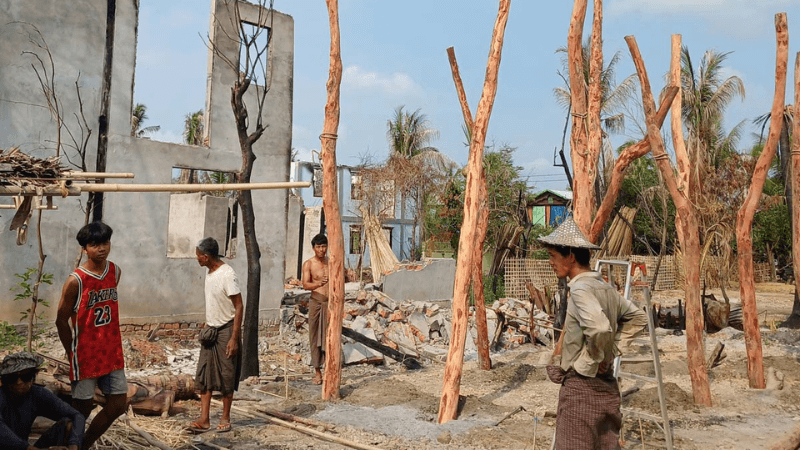
Local sources report that AA has extorted over 10 million Kyat from Rohingya business owners in Maungdaw Township under the pretext of funding road and bridge repairs. Despite these collections, the group is now coercing vulnerable Rohingya villagers—including children and the elderly—into grueling, unpaid labor.
Since (February 15), AA has enforced work quotas on at least 50 individuals per village in areas including Kyauk Hla Gyi, Maghla Gyi, Pawnza, and Hla Bawza. The tasks involve breaking stones, carrying heavy loads, and constructing roads in the sweltering heat. AA soldiers reportedly scold and insult those who attempt to rest. Furthermore, laborers are not provided food or water, forcing them to bring their own supplies despite their already dire financial conditions.
“We are daily laborers who need to earn money for our families to maintain our shelters. If we are forced to work for AA, our families will have nothing to eat,” one Rohingya worker lamented.
Adding to the dangers, many of these forced labor sites are in conflict-prone areas with a risk of landmines and unexploded ordnance. Each worker is compelled to participate at least four times a month, with no end in sight for these labor demands.
This latest development follows a February 14 directive where AA pressured Rohingya village leaders to assist with security duties ahead of the Islamic event Shab-e-Barat. While some media outlets portrayed these actions as voluntary community support, locals insist that AA’s coercion is behind these activities.
AA’s Rise as an Autocratic Power
The Arakan Army, initially seen as a resistance movement against the Myanmar military, has increasingly taken on the characteristics of an autocratic governing force in the regions it controls. The group has imposed strict curfews, forced civilian cooperation, and extracted financial resources from businesses and individuals.
Analysts note that AA’s actions mirror the authoritarian tactics of Myanmar’s military regime, creating new challenges for marginalized communities, especially the Rohingya, who have long faced persecution. By enforcing unpaid labor and controlling civilian movements, AA is cementing its authority over northern Rakhine State in ways that severely limit human rights and economic freedoms.
Human rights advocates are now urging the international community to take immediate action, warning that forced labor under such conditions further endangers the already vulnerable Rohingya population. If unchecked, the Arakan Army’s authoritarian rule could deepen the humanitarian crisis in Rakhine State, making prospects for peace and stability even more elusive.