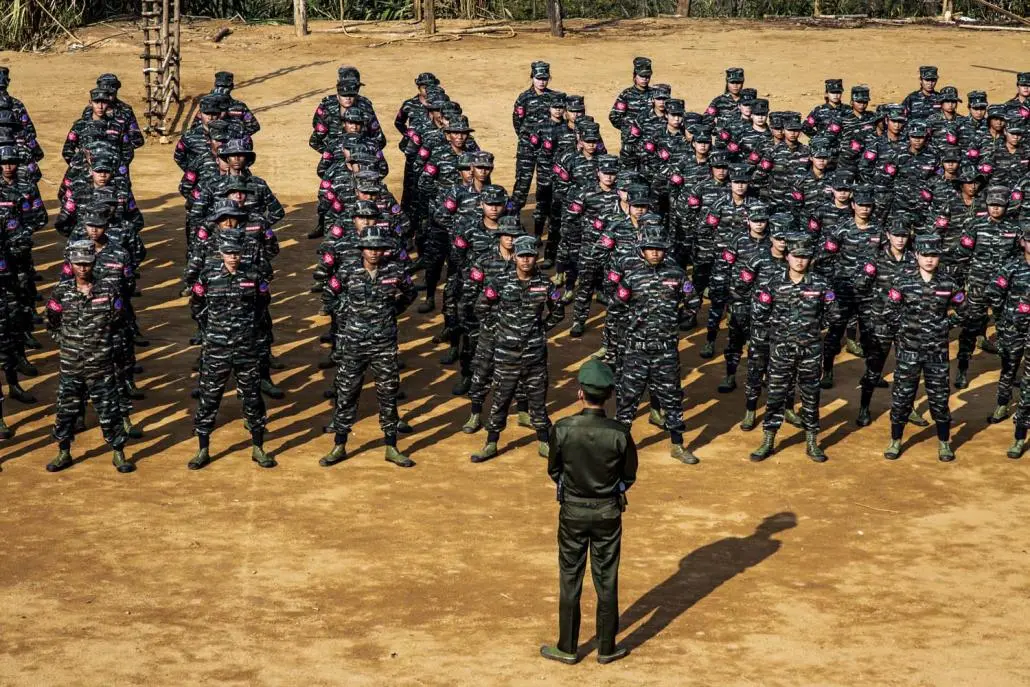
While the Arakan Army (AA) promotes newly formed administrative bodies like a "jury" and a "Muslim Affairs Council" as evidence of its inclusive governance, Rohingya activists, refugees, and human rights monitors paint a starkly different picture. They label these moves a cynical "double standard" designed to placate the international community while the AA simultaneously engages in systemic oppression, derails repatriation efforts, and profits from a burgeoning narcotics trade.
This critical view stands in stark contrast to recent optimistic portrayals, most notably a October 1 interview with U Bassel, the AA-appointed head of the Maungdaw district jury, published by The Irrawaddy. Critics argue that such carefully managed interviews obscure the grim reality for many Rohingya living under AA control.
"They talk of juries and councils, but on the ground, their soldiers demand 'taxes' from families who have nothing. They recruit our young men by force, and anyone who questions them is branded a spy for ARSA (Arakan Rohingya Salvation Army)," said a Rohingya community elder from Buthidaung, speaking to our correspondent this week in the Kutupalong refugee camp in Cox's Bazar. He spoke on condition of anonymity for fear of reprisal against his family. "This is not governance; it is occupation with a new face."

Recent incidents appear to corroborate these claims. In the last week of September, verified reports from local media outlets and corroborated by the human rights group Fortify Rights emerged from the Mayu mountain range. These reports detailed the razing of at least two Rohingya hamlets. The AA claimed the villages were harboring militants from the Rohingya Solidarity Organisation (RSO), a charge local vehemently deny. Survivors, whose accounts were documented by the rights group, claim the destruction was a collective punishment after village leaders refused to hand over a portion of their harvest and three teenage boys for "military service."
Furthermore, the AA's public stance on Muslim inclusion is seen by many as a strategic maneuver to consolidate control, a key element of which is preventing the large-scale return of nearly one million Rohingya refugees from Bangladesh.
An analyst with the Bangkok-based security think tank, the Irrawaddy Delta Security Monitor (IDSM), noted in a recent briefing, "The AA's primary objective is the realization of their 'Way of Rakhita,' which is an ethno-nationalist project. The presence of a million returning Rohingya complicates this demographically. By creating a thin veneer of inclusivity with hand-picked leaders, they can claim to be benevolent rulers while their actions such as -seizing land, creating instability, and refusing to engage with international repatriation frameworks ensure the camps in Bangladesh remain a permanent fixture."
Allegations of the AA’s deep involvement in the narcotics trade further tarnish its image. These accusations are bolstered by findings cited in a confidential brief, reportedly from the UN Office on Drugs and Crime (UNODC) and circulated among regional diplomats last month, which identified AA-controlled territory as a major production and transit hub for methamphetamine. Critics allege that the revenue from this trade is the primary funding source for the AA’s military expansion.
"You cannot be a legitimate government and a drug cartel at the same time," the IDSM analyst added. "The immense profits from the drug trade give them the means to suppress all dissent. The so-called 'jury' has no power to investigate or halt these criminal enterprises because the AA itself is the beneficiary."
While the AA points to Muslim members in its ranks as proof of progress, many Rohingya see these individuals as being co-opted. They argue that true inclusion would mean justice for past atrocities and a clear pathway for repatriation neither of which, they claim, are currently on the AA's agenda. For the majority of Rohingya, the AA's new administrative mechanisms are not a step towards reconciliation, but a new chapter in their long history of persecution.
BOB Post