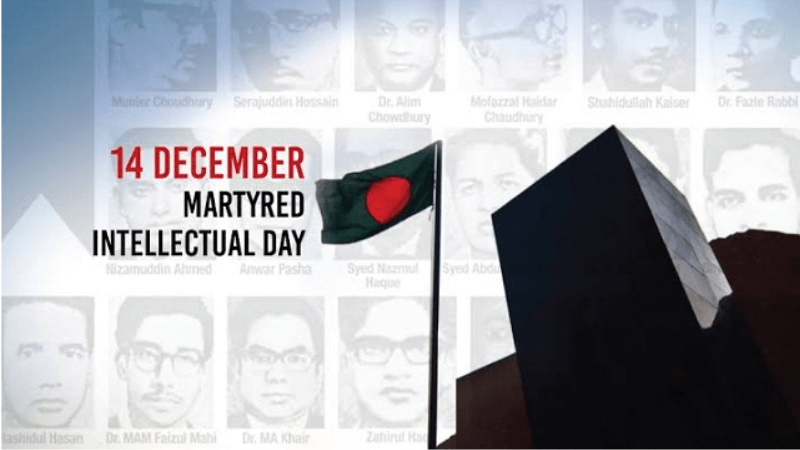
Today, December 14, the day is celebrated in Bangladesh with due dignity as Martyr Intellectuals Day. Just before the victory of the liberation war of 1971, the Pakistani ruling group killed the country's intellectuals. The massacre was planned by the Pakistani army and their local allies Albadar, Alshams. The day is considered as a dark chapter in the history of freedom and liberation struggle of the country.
Among the martyred intellectuals, Professor Munir Chowdhury, Dr. Alim Chowdhury, Professor Muniruzzaman, Dr. Fazle Rabbi, Siraj Uddin Hossain, Shahidullah Kaiser, Professor GC Dev, Jyotirmoy Guhathakurta, Professor Santosh Bhattacharya, Mofazzal Haider Chowdhury, Professor Ghiyas Uddin, Professor Anwar Pasha, Professor Rashidul Hasan, Dr. Abul Khair, Dr. Murtaza, journalist Khandaker Abu Taher, Nizamuddin Ahmed, SA Mannan (Ladu Bhai), ANM Ghulam Mostafa, Syed Nazmul Haque, Selina Parveen and many others.
Historians believe that the then West Pakistanis realized the defeat and took revenge by killing intellectuals to demoralize Bangladesh (then East Pakistan). The local allies of Pak army abducted prominent people of various professions including teachers, journalists, doctors, lawyers, engineers, cultural workers from various places including the Dhaka University campus. On the eve of victory, they were taken to Rayerbazar and Mirpur slaughterhouses in Dhaka and shot and killed brutally. This incident took place between 10 and 14 December in the last phase of the Liberation War.
They say, the role of intellectuals was immense in energizing the Bengali nation to jump into the battlefield for the liberation of the country. Intellectuals played an important role in forming the Mujibnagar government for conducting the armed liberation war, dividing different areas into different sectors and assigning responsibilities as sector heads, establishing various institutions of the first government of Bangladesh and assigning responsibilities to various individuals in these institutions and gaining the support of the international community.
Basanti Guhthakurta, the wife of Shaheed Jyotirmoy Guhthakurta, a teacher of Dhaka University, wrote in one of her books, "The drawing of blue lines started before March 17, 1971, before the referendum on December 17, 1970, or much earlier, since the mass movement of 1979, or after the 52 language movement. In 1971 they (Pakistani ruling group) planned and went to war. Not war, just killing unarmed people. First, they were killed indiscriminately, then the rich, businessmen and intellectuals were selectively killed in the cities and villages and thrown into the canals. Many think that disaster is imminent, that defeat is imminent—then they execute the plan. Enlisted intellectuals were blindfolded and killed. They planned to darken the future of independent Bangladesh in this way.'
BOB Post