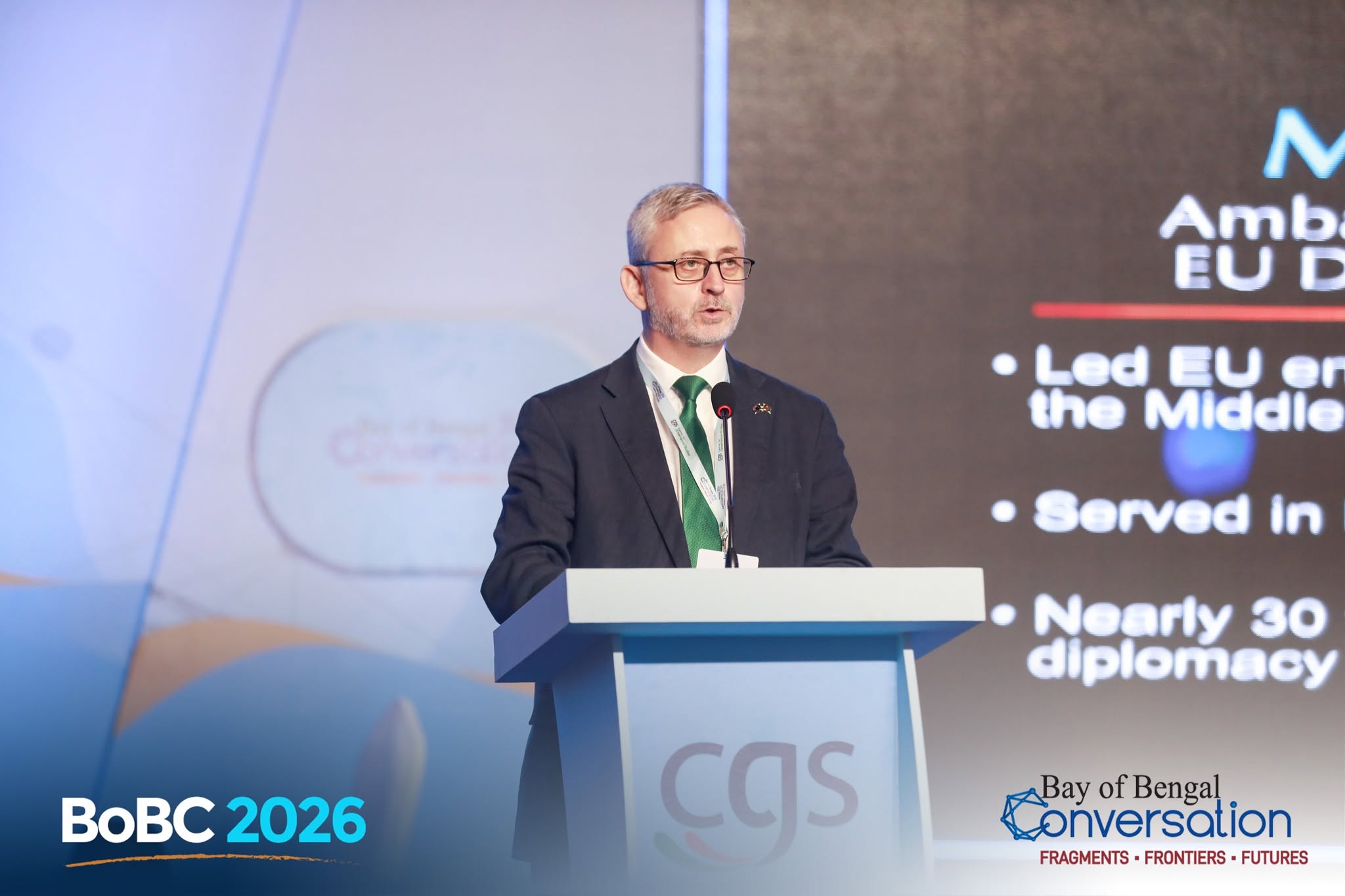
Bangladesh has the potential to become one of the world’s 30 largest economies by 2030, European Union Ambassador Michael Miller has said, describing the country as an increasingly important strategic partner in South Asia and the wider Indo-Pacific.
Speaking at the Bay of Bengal Conversation at the Pan Pacific Sonargaon Hotel in Dhaka on Sunday, Miller said Bangladesh was entering a decisive phase as it prepares to graduate from the least developed country (LDC) category.
He said the country would have to manage several challenges at the same time, including political transition, institutional reforms, economic pressures, climate change and a rapidly changing regional and global environment.
“Against this backdrop, we view Bangladesh as a partner of growing strategic importance,” Miller said, stressing that the EU wanted to build a relationship that went beyond the traditional donor-recipient model.
According to BD Pratidin, the EU is seeking to support Bangladesh’s smooth LDC graduation while also exploring the possibility of negotiating a future free trade agreement (FTA) with Dhaka.
Miller said the EU’s proposal to explore an FTA before Bangladesh’s LDC graduation would be a first-of-its-kind initiative. However, he said both sides would first need to assess whether there was enough common ground for such an agreement.
He pointed to the EU’s existing FTAs with India and Vietnam, saying a potential deal with Bangladesh would be closely linked to accountable institutions, the rule of law, labour and human rights, environmental protection and good governance.
“These elements are the core issues, not secondary at all,” he said.
The EU envoy also highlighted the need for Bangladesh to develop a more skilled workforce, diversify its exports and strengthen green growth and infrastructure. He said stronger institutions and oversight would be essential to attract investment and generate employment for the country’s growing young population.
Miller said the EU was interested in combining European investment with technology, international standards, long-term financing and innovation. He cited the Laldia Container Terminal in Chattogram and green bonds as areas where cooperation could expand.
The ambassador also offered European experience in public administration and institutional reform, including lessons from countries that transitioned from authoritarian rule to democratic systems.
He said such cooperation could help Bangladesh strengthen its global competitiveness while remaining “open, sovereign, resilient, and connected” in an increasingly complex international environment.
BOB Post