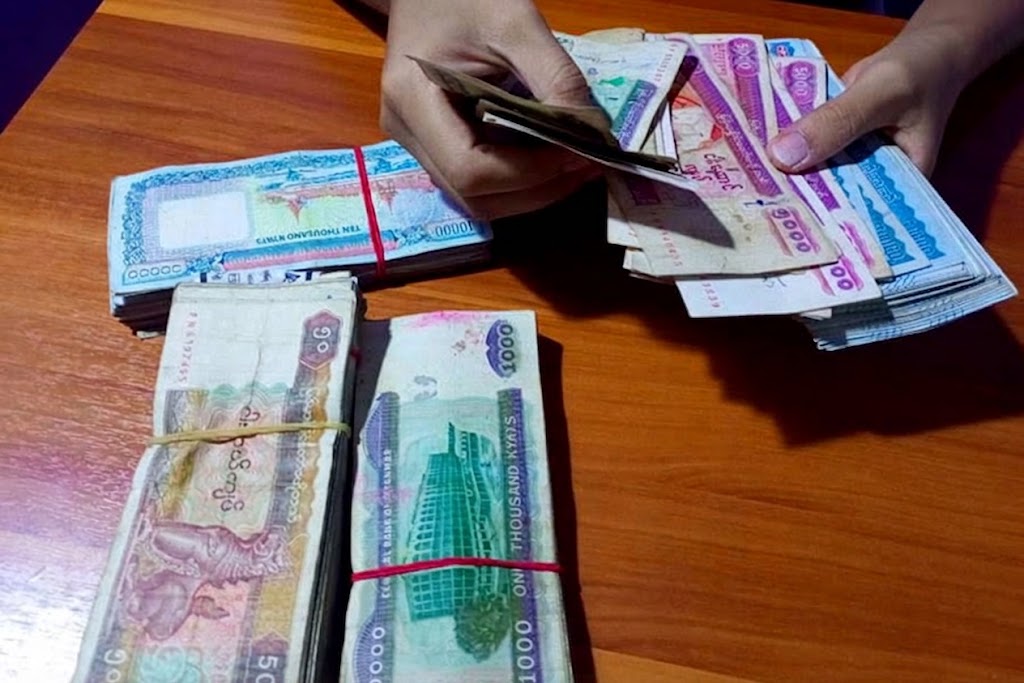
A worsening cash shortage in Myanmar’s Rakhine State has pushed up the cost of withdrawing money, with residents now paying service fees of more than 5% and as much as 6% in some areas, according to local sources.
The withdrawal rate has fluctuated from day to day, but has recently remained at around 6%, a money-transfer and cash withdrawal service provider in Mrauk-U told Western News.
“The rate does not remain the same every day. But recently, it has not fallen below 6% because of the shortage of cash,” the service provider said, adding that declining money-transfer flows have also contributed to the shortage.
Local sources said the cash crunch has become more severe during the 2026 monsoon season. In previous months, withdrawal charges generally ranged between 1% and around 3%.
Residents said the closure of the Sawkun route, an important transportation and trade route in Rakhine, by Myanmar’s military has disrupted the movement of goods and reduced the flow of money into local markets.
The decline in commercial activity has further affected the availability of cash, creating a widening gap between demand for cash and its supply.
A resident of Ponnagyun Township said people now face additional expenses when travelling to withdraw money.
“To withdraw 100,000 kyats, we have to pay 6,000 kyats,” the resident said. “The cost has increased recently, making it difficult to access cash. We do not receive the full amount that is sent to us, and we also have to pay for transportation to collect the money. By the time we can use the money, a significant portion is already gone.”
Banking services in Rakhine have remained severely disrupted since 2023 because of conflict and restrictions on transportation. As a result, money-transfer networks and cash withdrawal services have become important channels for local financial transactions.
With conventional banking services unable to operate normally, the availability of physical cash has declined. At the same time, reduced money-transfer activity has placed additional pressure on the limited cash supply.
Local residents and service providers say the combination of disrupted trade, restricted transportation, weakened banking operations and lower money-transfer flows is driving the shortage.
As the imbalance between cash demand and supply continues to widen, withdrawal charges have risen accordingly, reaching as high as 6% in some parts of Rakhine State.
The rising cost of accessing cash is adding another financial burden for residents already facing economic difficulties caused by prolonged conflict and disruption to trade and transportation.
BOB Post