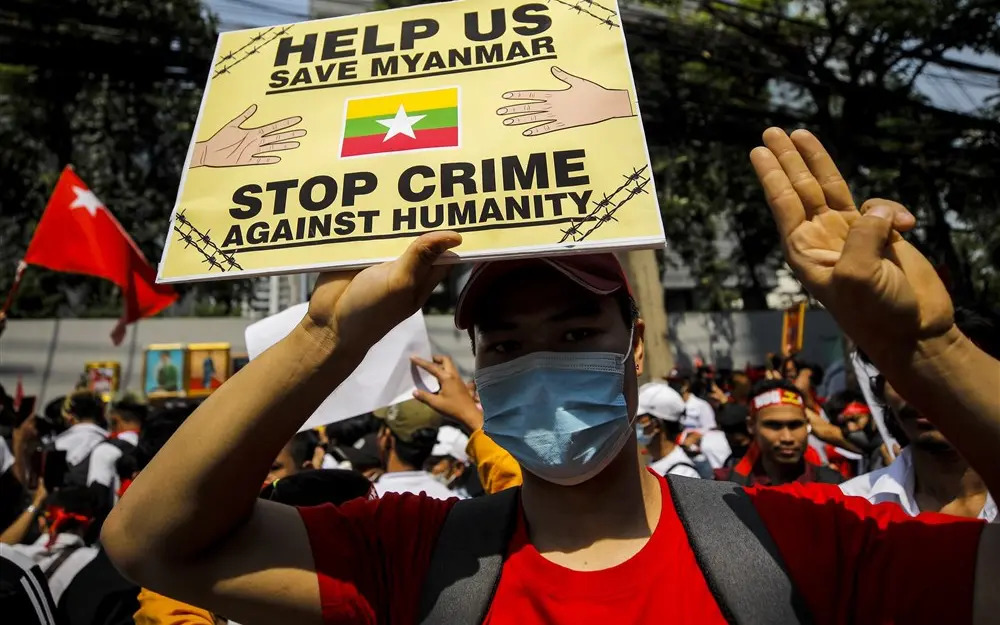
The human rights situation in Myanmar has “plummeted to a new low”, with civilians facing escalating violence, displacement, hunger and abuses, according to a new report by the United Nations Human Rights Office.
The report, released Tuesday, said the Myanmar military’s efforts to consolidate control and legitimacy since its 2021 coup have deepened the suffering of civilians, as fighting continues across the country.
The military has used airstrikes, arson, forced displacement and restrictions on humanitarian assistance in its operations against ethnic armed groups and militias, the UN said.
An estimated 8,075 civilians, including 1,074 children, have been killed since the coup, with at least 1,241 deaths recorded over the past year. The UN warned that the actual toll could be considerably higher, with open-source information indicating that as many as 15,731 civilians may have been killed since 2021.
The conflict has also pushed the number of internally displaced people to about 3.6 million, while 12.4 million people are facing acute hunger. Around 400,000 young children and mothers are suffering from acute malnutrition, according to the report.
In western Rakhine State, the UN said both the Myanmar military and the Arakan Army have been responsible for widespread and systematic violations against the mostly Muslim Rohingya minority. According to Al Jazeera, the latest UN findings come nine years after the military’s 2017 crackdown that forced about 700,000 Rohingya to flee across the border into Bangladesh.
The UN report accused the Arakan Army of arbitrary arrests, torture, sexual and gender-based violence, forced labour and recruitment, as well as the destruction of villages and religious sites.
Rohingya attempting to escape forced recruitment have reportedly been detained and subjected to severe ill-treatment. Former detainees described beatings and other forms of torture, according to the UN.
The report also highlighted the growing illicit economy in Myanmar, including illegal rare-earth mining in Kachin and Shan states. Satellite imagery identified 302 new mining sites in Kachin State since 2021, representing a 149 percent increase.
The UN said mining operations have caused serious environmental contamination, with chemical and heavy-metal exposure linked to increased miscarriages and other pregnancy complications.
UN High Commissioner for Human Rights Volker Türk described the findings as deeply troubling, saying the report presents a picture of “suffering, misery, and cruelty” across Myanmar.
Türk called on governments, companies and investors to reconsider their involvement in Myanmar and urged them to examine whether their actions or inaction were contributing to the continuing suffering of the country’s population.
The latest UN assessment underscores the increasingly regional dimensions of Myanmar’s crisis, with conflict, mass displacement, humanitarian pressures, environmental degradation and the Rohingya crisis continuing to affect neighbouring countries, particularly Bangladesh.
BOB Post