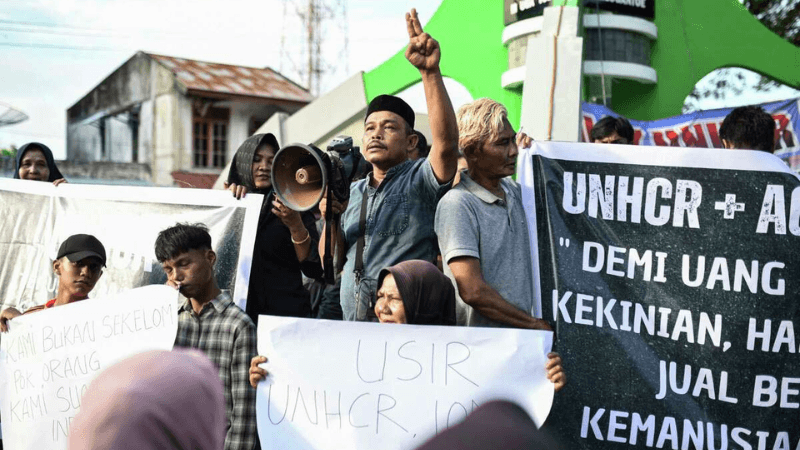
In a striking manifestation of local resistance, over 200 people protested on Sabang island, off the western tip of Aceh in western Indonesia, against the recent surge in Rohingya refugees arriving by boat. The demonstrators, primarily comprised of local residents and students, voiced concerns that the sudden influx threatens to overwhelm their communities. The protest took place following the arrival of two boats on November 21 and December 2, carrying more than 1,500 Rohingya civilians, including women and children.
The deteriorating conditions in the refugee camps of southeastern Bangladesh have driven the Rohingya to brave perilous ocean voyages, seeking refuge elsewhere. The majority of these refugees arrived in Bangladesh in 2017 after the Myanmar military expelled over 700,000 Rohingya civilians from Rakhine State. The recent surge in arrivals, prompted by improved weather conditions, has shifted the burden to Indonesia, particularly Aceh.
Local protesters, holding signs that read “Kick out UNHCR and IOM” and “UNHCR and its agents, do you really want to trade humanity for money?”, called on authorities and international organizations, including the UN refugee agency UNHCR and the International Organization for Migration (IOM), to remove all Rohingya refugees from Sabang island. They argued that the local community is already strained and cannot accommodate additional people.
As of December 12, UNHCR and IOM reported approximately 1,722 Rohingya refugees in Aceh, with expectations that this number could rise to as many as 2,000 by the year's end and possibly 3,500 by the end of March 2024. The refugees, fleeing persecution in Myanmar and deteriorating conditions in Bangladeshi camps, have sought sanctuary in Aceh for years.
While Aceh has been historically known for its hospitality toward foreign arrivals, the recent wave of refugees has met with resistance and even hostility. Villagers have pushed refugee boats back to sea instead of providing assistance, citing reasons such as social media publicity, perceived lack of gratitude for past aid, cultural misunderstandings, and alleged involvement of Acehnese villagers in smuggling Rohingya to Indonesia
In response to the growing refugee crisis, Indonesia's government is considering more permanent solutions. One option being explored is the reopening of the refugee camp on Galang Island, located in the Riau Archipelago. This camp, active from 1975 to 1996, previously accommodated a quarter of a million refugees from Vietnam and other parts of Indochina. The Ministry of Foreign Affairs, emphasizing that Indonesia is not a signatory of the 1951 Refugee Convention, stated that the country has no obligation to accommodate refugees permanently and that its “kindness in providing temporary shelter has been misused by people smugglers.”
Despite increasing domestic pressure, Indonesia has called on the international community to assist with the growing refugee burden. Foreign Ministry spokesperson Muhammad Iqbal urged the world to "show more responsibility in efforts to resolve the Rohingya refugee problem," emphasizing the slow progress in handling the resettlement issue.
With the Rohingya crisis persisting and Indonesia grappling with the challenges posed by the influx, it appears that the country may need to find its own solutions to address the ongoing refugee crisis in the region. As the situation continues to evolve, the international community's role in providing support and solutions remains crucial.
BOB Post