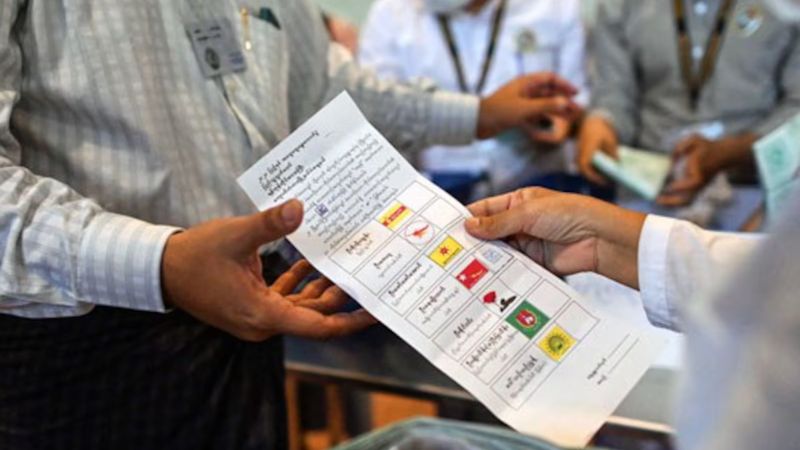
Myanmar’s military junta has announced plans to hold national elections by January 2026, despite mounting concerns that such a move would be neither free nor fair. The announcement was made on Saturday by Senior General Min Aung Hlaing during his visit to Belarus, as the junta seeks international legitimacy for its rule, which has been marked by brutal repression and ongoing violence since its February 2021 coup.
The junta’s planned elections are widely seen as a way to solidify its control over the country, despite the growing resistance from ethnic armed groups and pro-democracy forces. The military’s power is shaky, with large parts of the country under the influence of opposition groups and ethnic militias that have been fighting back against the regime’s brutality. Human rights groups and experts have already condemned the election plans as a farce designed to maintain the junta’s hold on power.
Repression and Election Sabotage
Under the junta's rule, Myanmar has descended into chaos. The military has committed numerous atrocities against its own people, including arbitrary detentions, torture, and the destruction of entire villages. Political opposition parties have been dismantled, and their leaders have either been imprisoned or forced into exile. The junta has also made it virtually impossible for free political activity to thrive, dissolving political parties and criminalizing dissent.
The regime's control over the country is increasingly tenuous. The junta conducted a controversial nationwide census in October 2024, which was supposed to help prepare voter lists for the upcoming elections. However, reports suggest that the exercise was little more than a counterinsurgency operation aimed at rooting out opposition activists and conscripting soldiers. Out of 330 townships, the military claims it only managed to carry out the census in 145 – less than half of the country. This highlights the junta’s inability to hold elections on a national scale.
Moreover, the military continues to destroy any semblance of an independent electoral system. Voting infrastructures, such as election commissions, have been undermined by attacks on government buildings and the strategic targeting of election officials who oppose the junta. The growing atmosphere of fear and uncertainty makes it clear that holding credible elections in this environment is impossible.
International Reactions: Divided and Concerned
While Myanmar’s junta continues to move forward with its election plans, support from the international community is far from unified. Countries like China and Belarus have expressed support for the junta’s efforts. Min Aung Hlaing has sought China’s backing for the elections, discussing the issue with Chinese Foreign Minister Wang Yi in August and Premier Li Qiang in November 2024. Belarus, whose leader Aliaksandr Lukashenka recently secured a contested and internationally unrecognized seventh term, has also offered to send election observers to Myanmar, despite their own questionable democratic processes.
However, many Southeast Asian nations and global powers are less eager to endorse the junta’s election plans. ASEAN members are divided on the issue, with Cambodia’s former prime minister, Hun Sen, suggesting his country could provide support by sending election observers. Cambodia has a long history of flawed elections where political opposition was systematically silenced and irregularities were widespread. In contrast, Malaysia’s Foreign Minister Mohamad Hasan stated, “We told them [Myanmar’s junta] that election is not a priority at the moment,” reflecting the growing unease in the region about the junta’s ability to hold any legitimate election.
International human rights organizations and UN experts have been outspoken in their condemnation of the junta’s election plans. They have urged member states to label the election a "fraud" and warned that supporting the process would only legitimize the military's hold on power. The United Nations Special Rapporteur on Myanmar, Tom Andrews, called for a global stance against the elections, stressing that they would only serve to deepen Myanmar’s crisis.
Uncertainty Looms
The growing uncertainty surrounding Myanmar’s future raises concerns about the country’s stability. With the junta’s control over large parts of the country increasingly contested, many fears that elections under such conditions will only further deepen the divide. As violence and civil war continue to ravage Myanmar, the prospect of a political transition through elections seems remote at best.
The uncertainty surrounding Myanmar’s political future remains palpable, with no clear path to peace or democratic restoration in sight. As the military junta continues to suppress dissent and destroy the infrastructure needed for free and fair elections, it remains to be seen whether Myanmar will ever see a legitimate return to democracy.
For now, Myanmar's people remain trapped in an ever-tightening grip of military rule, with their hopes for a peaceful and democratic future growing increasingly distant.
BOB Post