Myanmar's military regime has claimed it has regained control of a key section of the India-Myanmar-Thailand (IMT) Trilateral Highway, saying the development could pave the way for the resumption of border trade with India. However, resistance groups and Myanmar's civilian National Unity Government (NUG) have strongly disputed the claim, insisting that large parts of the route remain under resistance influence.
According to the regime, its forces reached Kalewa on July 7 after a month-long offensive that captured 16 villages along the Monywa–Yagyi–Kalewa road in Sagaing Region. The operation followed regime leader Min Aung Hlaing's pledge during his visit to India in late May and early June to reopen the strategic overland trade corridor linking India with Myanmar and Southeast Asia.
Resistance forces, however, dismissed the announcement as premature. Fighters from local People's Defense Forces (PDFs) said the military had only managed to move troops through parts of the highway and had not established full territorial control. The NUG also acknowledged that the military may have temporarily secured certain sections but said the situation remains fluid due to ongoing fighting.
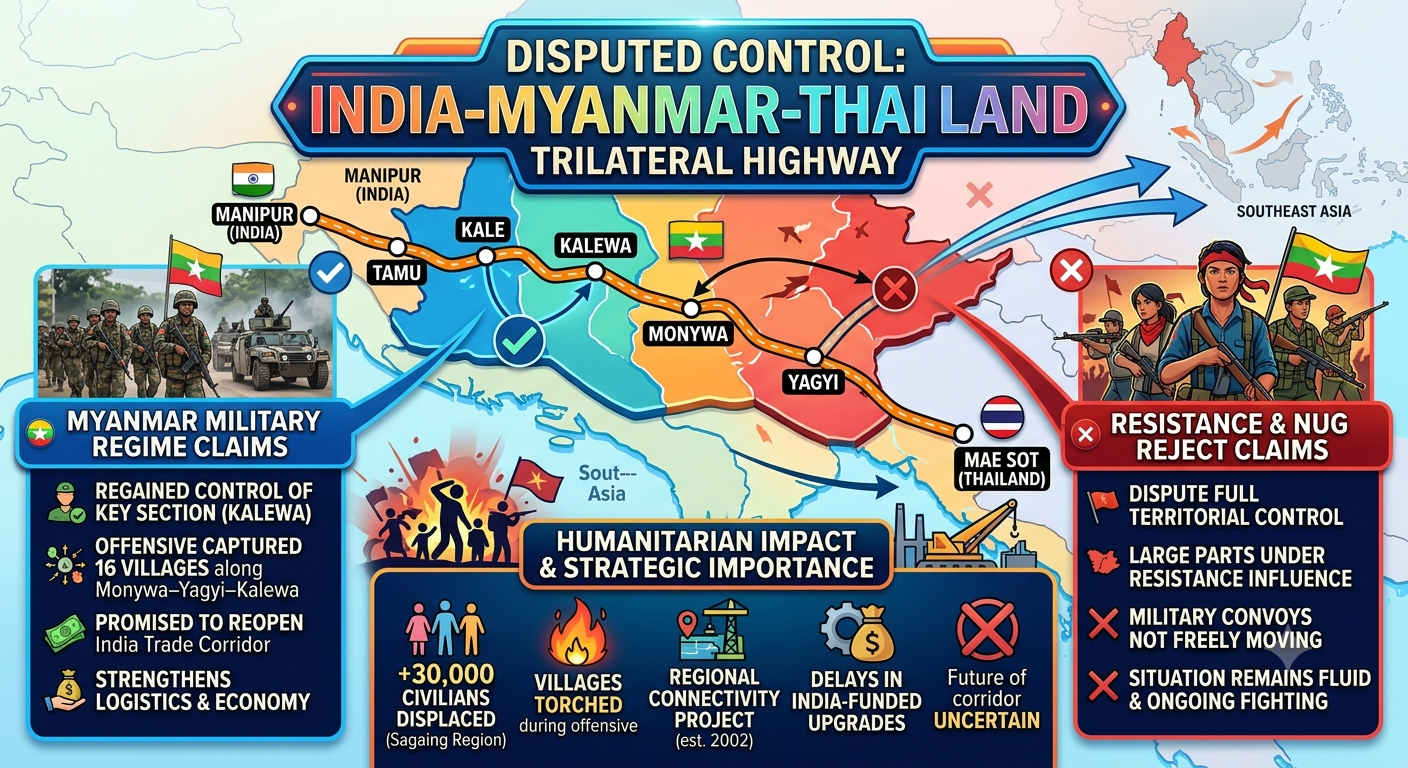
According to The Irrawaddy, local resistance groups reported that the military offensive forced more than 30,000 civilians to flee after villages were torched in Sagaing Region. The publication also quoted former military officer and defector Zin Yaw as saying that the route is strategically important not only for trade with India but also for reconnecting military bases in Kale, Mawlaik and Hkamti. He noted that the regime cannot claim full control until its military convoys are able to move freely along the entire Monywa–Yagyi–Kalewa road.
The disputed highway forms part of the India-Myanmar-Thailand Trilateral Highway project, a major regional connectivity initiative launched in 2002. The route extends from India's Manipur state through Myanmar to Thailand's Mae Sot, but years of armed conflict have delayed the completion of India-funded road upgrades and bridge construction along the corridor.
Despite the regime's latest announcement, clashes continue on other sections of the highway, particularly between Kale and Tamu near the Indian border. Analysts say reopening the trade route would strengthen the junta's military logistics while also improving its diplomatic and economic engagement with neighboring India. However, with fighting continuing across Sagaing Region, the future of the corridor remains uncertain.
BOB Post