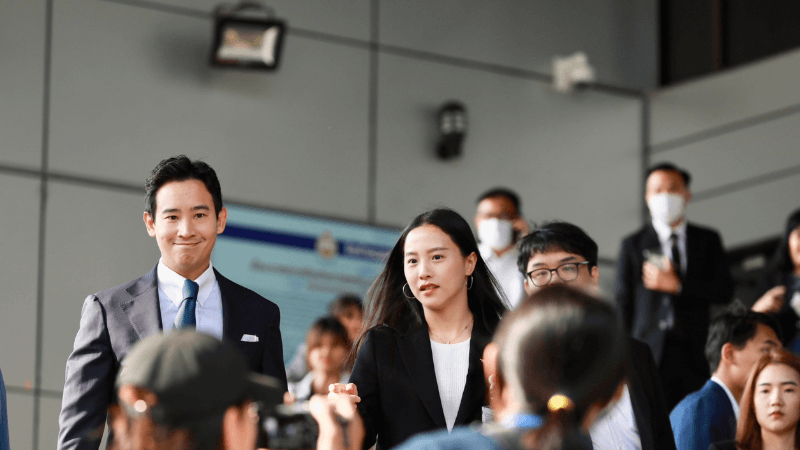
Thai court sentenced Rukchanok Srinork, a member of the progressive Move Forward Party (MFP), to six years in prison for violating Thailand's stringent lese-majeste laws. The court found Srinork guilty of insulting the monarchy through social media posts, reigniting concerns about freedom of expression in the country. The charges against Srinork stemmed from two social media posts on the platform X (formerly Twitter) in 2020. One post criticized the government's handling of the COVID-19 pandemic, while the other was a retweet deemed critical of the monarchy. Prominent in the MFP, Srinork's conviction has triggered outrage from human rights groups and advocates for free speech. Amnesty International condemned the sentence as "draconian" and "a blatant attack on freedom of expression." The MFP accused the government of using lese-majeste laws to stifle dissent.
Thailand boasts some of the world's strictest lese-majeste laws, making it illegal to criticize or insult the king, queen, or other royal family members. The penalty for violating this law is a prison term of up to 15 years. These laws have been widely employed to suppress opposition and criticism, particularly since the 2014 military coup. The international community, including the United Nations Human Rights Council, has repeatedly called for the reform or repeal of these laws, arguing that they violate international human rights standards.
The utilization of lese-majeste laws has generated widespread criticism for stifling freedom of expression in Thailand. With over 200 lese-majeste cases since the 2014 coup, the laws have instilled fear and self-censorship, creating a climate where individuals are hesitant to speak out against the government or monarchy. Srinork's case exemplifies how lese-majeste laws are wielded to silence dissent. The conviction sends a chilling message to critics, reinforcing the atmosphere of fear and self-censorship. The international community remains crucial in pressuring Thailand to amend or repeal these laws, aligning them with international human rights standards. The international community, including human rights groups, has consistently criticized Thailand's use of lese-majeste laws. The United Nations Human Rights Council has urged Thailand to reform or repeal these laws, asserting their incompatibility with international human rights norms. Numerous instances have been documented where individuals faced lese-majeste charges for exercising their right to freedom of expression. The broad powers granted by the Computer Crimes Act, coupled with the lese-majeste laws, contribute to the suppression of free speech.
Rukchanok Srinork has been released on bail pending an appeal. The MFP has expressed its determination to continue advocating for lese-majeste law reform. Human rights groups are urging the international community to take action to protect freedom of expression in Thailand. This case is part of an ongoing trend where lese-majeste laws are wielded as a tool to curb dissent, creating a climate of fear and suppressing the fundamental right to freedom of expression. The evolving situation will be closely monitored, and updates will be provided as new information emerges.
*Note: The information provided is based on available sources, and the situation may develop further.*
BOB Post