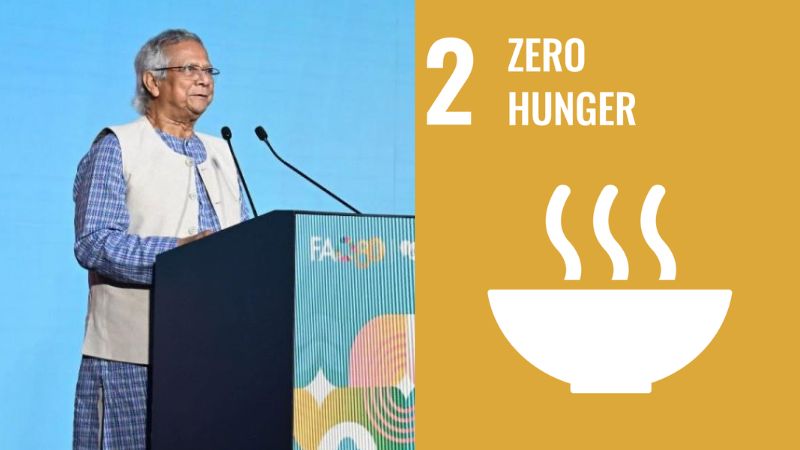
Chief Adviser of Bangladesh's interim government, Professor Muhammad Yunus, delivered a powerful call to action for a complete reformation of the global food and economic systems, presenting a six-point proposal to create a world free from hunger. In his keynote address at the opening ceremony of the World Food Forum (WFF) 2025 at the UN's Food and Agriculture Organization (FAO) headquarters, he asserted that hunger is a product of systemic failure, not scarcity.
"Hunger is not caused by scarcity. It is caused by the failure of the economic framework we have designed. We must change this system," Professor Yunus declared on Monday(October 13).
At the heart of his address, Professor Yunus outlined a comprehensive six-point proposal to reform the global food and economic architecture:
End Conflict and Ensure Food Access: He urged global leaders to "stop the wars, start the dialogue, and ensure food access in conflict zones" to break the vicious cycle of hunger and conflict.

Fulfill Global Commitments: He called for the fulfillment of financing commitments for the Sustainable Development Goals (SDGs), serious climate action, and support for the most vulnerable populations to build resilience.
Establish Regional Food Banks: To manage shocks and stabilize supply chains, he proposed the creation of regional food banks.
Empower Young Entrepreneurs: Yunus emphasized the need to support local and youth entrepreneurs with finance, infrastructure, and global partnerships.
Lift Export Bans: He advocated for the removal of export bans, stating that "trade rules must support food security, not undermine it."
Ensure Access to Technology: He stressed the importance of ensuring access to and development of technology and innovation, particularly for the youth and farmers in the Global South.
Professor Yunus highlighted a stark moral and economic paradox. "In 2024, 673 million people went hungry. Yet we produce more than enough food. This is not a failure of production,it's a failure of the economic system. It's a moral failure," he stated. He pointedly contrasted the world's priorities, noting, "While we couldn't raise a few billion dollars to end hunger, the world spent 2.7 trillion dollars on weapons. Is this how we define progress?"
The Nobel Peace laureate championed the concept of "social business"enterprises designed to solve social problems without seeking personal profit as a critical alternative to the traditional profit-maximizing model that he says "has left billions behind." He cited the success of Grameen Bank in empowering poor women to become entrepreneurs and Grameen Danone's work against child malnutrition as powerful examples from Bangladesh. "We must create social business funds to support young entrepreneurs, women, farmers, agri-business creators, and technology developers. We must build legal and financial frameworks to support this kind of entrepreneurship not stand in1 its way," he urged.
Central to his vision is the creation of a "Three-Zero World": a world with zero poverty, zero unemployment, and zero net carbon emissions. "This is not a dream. It is a necessity, the only way to save the world," he affirmed.
Professor Yunus placed significant emphasis on the role of youth, describing today's young generation as more connected, creative, and technologically adept than ever before. "Don't tell them to look for jobs; empower them to become job creators," he said. "If we invest in youth, we will not only feed the world, we will change the world."
He also highlighted Bangladesh's achievements in food production, noting the country is self-sufficient in its staple, rice, and is a leading producer of vegetables and freshwater fish, all while feeding a population of 170 million and hosting 1.3 million Rohingya refugees.
Referencing the recent youth-led movement in Bangladesh, he said young people are now working to build a new nation centered on justice and inclusion, with a national election scheduled for February to institutionalize these commitments.
Concluding his address on the 80th anniversary of the FAO, Professor Yunus called for collective action. "Let us work together to build a Three-Zero World," he implored, adding, "If we can imagine it, we can create it."
BOB Post