India's ambitious effort to reduce its dependence on Chinese solar imports is facing an unexpected setback, with dozens of domestic solar panel manufacturers reportedly shutting down production due to shortages of locally produced solar cells.
The crisis has exposed the challenges of New Delhi's "Atmanirbhar Bharat" (Self-Reliant India) strategy, raising concerns that political ambitions to decouple from China may be outpacing India's industrial readiness.
Since June 1, 2026, the Indian government has required most solar projects to use domestically manufactured solar cells instead of imported ones. The policy is intended to strengthen India's manufacturing base, reduce strategic dependence on China, and build a secure renewable energy supply chain.
However, industry leaders argue that the policy has instead created a severe supply bottleneck.
Factories Falling Silent
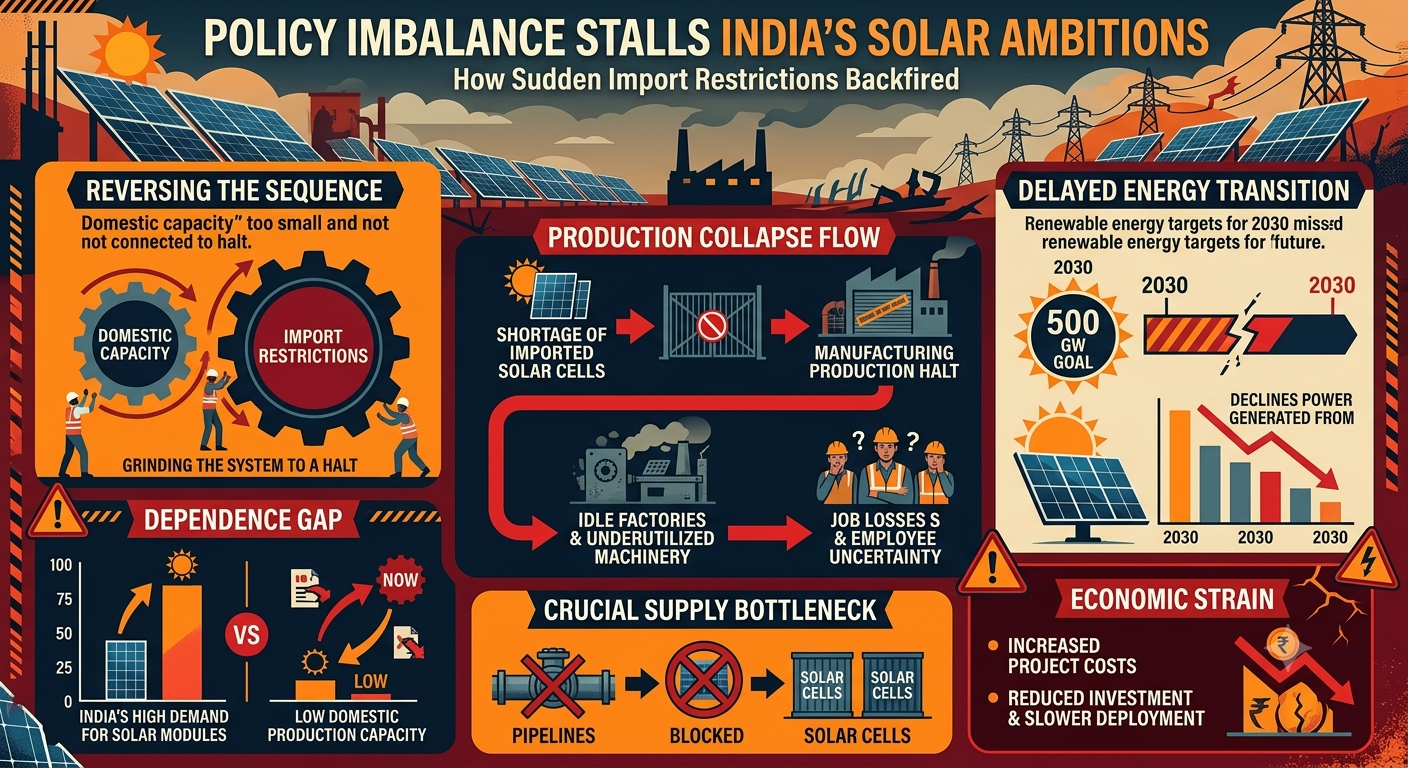
According to the All India Solar Module Manufacturers Association, nearly one-third of India's approximately 140 solar module manufacturers have already suspended operations within two months of the policy taking effect.
Many remaining factories have reportedly reduced production to only three or four days a week because they cannot obtain enough domestically manufactured solar cells.
The problem is straightforward: while India has developed significant solar module assembly capacity, it still depends heavily on imported solar cells- around 95 percent of which previously came from China.
Domestic production capacity remains far below demand.
Manufacturers say they may have to wait six to eight months to secure Indian-made solar cells, leaving factories idle and thousands of workers at risk.
Policy Ahead of Industrial Capacity
The crisis illustrates a broader challenge facing India's industrial policy. Rather than gradually expanding domestic manufacturing before restricting imports, the government effectively reversed the sequence- tightening import rules before sufficient local capacity existed.
Industry executives argue that establishing competitive solar cell manufacturing requires billions of dollars in investment, advanced technology, skilled manpower, and highly specialized equipment- none of which can be developed overnight. Although New Delhi announced the policy transition in advance, manufacturers insist the available preparation period was insufficient.
Strategic Logic Meets Economic Reality
The government's motivation is understandable. China dominates the global solar supply chain, controlling much of the world's production of polysilicon, wafers, solar cells, and manufacturing equipment.
Indian officials have repeatedly expressed concerns that excessive dependence on Chinese imports creates both economic and national security vulnerabilities. Last fiscal year alone, India's solar cell imports reportedly exceeded $1.8 billion, with China remaining the overwhelming supplier.
Reducing that dependence has become a strategic priority amid continuing geopolitical tensions between the two Asian powers. Yet the transition appears to have exposed the risks of industrial decoupling without adequate domestic preparation.
Renewable Energy Goals Under Pressure
The timing could hardly be more sensitive. India aims to expand its non-fossil electricity generation capacity to 500 gigawatts by 2030, with solar energy expected to provide nearly 300 gigawatts. Any prolonged disruption in solar manufacturing could slow project implementation, increase installation costs, and delay India's broader energy transition.
Industry groups warn that reduced manufacturing capacity may ultimately force developers to postpone projects or pay significantly higher prices for domestically produced components. That could undermine one of the Modi government's flagship climate and energy initiatives.
Employment Concerns Growing
Beyond energy security, the manufacturing slowdown threatens employment. India's solar manufacturing industry directly employs an estimated 75,000 workers, with a large concentration in Gujarat—Prime Minister Narendra Modi's home state.
If supply shortages continue for several more months, manufacturers warn that layoffs could become unavoidable. Small and medium-sized companies appear particularly vulnerable, lacking the financial reserves needed to withstand prolonged production disruptions.
Government Rejects Industry Claims
The Indian government has pushed back against reports of widespread factory closures. Officials from the Ministry of New and Renewable Energy maintain that domestic manufacturing capacity is expanding rapidly and argue that many integrated manufacturers already produce their own solar cells.
Authorities also insist that supply-demand gaps will narrow within the coming months as new production facilities begin commercial operations. However, manufacturers counter that many announced factories remain under construction or have yet to achieve full-scale commercial production.
A Test for India's Industrial Strategy
The dispute reflects a larger policy dilemma confronting India. Successive governments have sought to reduce dependence on Chinese imports across multiple sectors, from electronics and telecommunications to pharmaceuticals and renewable energy.
The objective enjoys broad political support. The challenge lies in ensuring that domestic industries are sufficiently prepared before import restrictions take effect. Otherwise, attempts to achieve self-reliance risk creating production disruptions that weaken the very industries they are intended to strengthen.
India's long-term ambition to build a globally competitive solar manufacturing ecosystem remains achievable. But the current turbulence suggests that industrial policy requires careful sequencing, balancing strategic independence with economic practicality.
Without sufficient manufacturing capacity, self-reliance can become less a symbol of resilience than a costly transition—one that risks slowing investment, threatening jobs, and complicating India's clean energy ambitions
EDITOR, Bay of Bengal Post