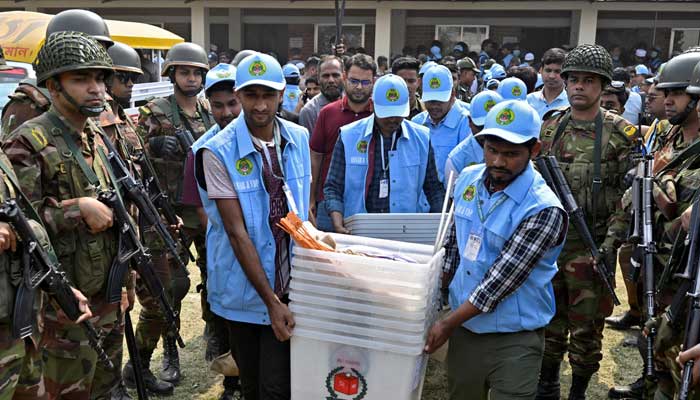
Bangladesh’s 2026 national election unfolded in a remarkably calm and orderly atmosphere, marking a crucial milestone in the country’s democratic recovery after years of political turmoil. The February 12 vote was the first full national election since the upheaval of mid-2024, which ended the long rule of Sheikh Hasina and brought Professor Muhammad Yunus’s interim administration to power.
From early morning, polling stations across the country saw a steady stream of voters. Balloting opened at 7:30 a.m. and closed at 4:30 p.m., with citizens also casting votes in a parallel referendum on the reform proposals outlined in the July National Charter. According to the Election Commission, voter turnout reached 59.44 percent, a notable rise compared with recent elections, reflecting renewed public engagement in national politics.
To ensure security and public order, authorities deployed an extensive multi-agency force of roughly one million personnel, drawing from the police, Border Guard Bangladesh (BGB), Rapid Action Battalion (RAB), Ansar, and Village Defence Party (VDP). At the heart of this vast operation was the Bangladesh Army, which fielded between 100,000 and 108,000 troops the largest deployment for any election in the nation’s history.

Throughout the day, soldiers maintained a steady, reassuring presence. Their conduct was marked by restraint, neutrality, and professionalism qualities emphasized repeatedly by General Waker-uz-Zaman in pre-election briefings and inspection visits. The Army’s disciplined posture helped defuse tensions in areas that had experienced unrest in previous months, especially where fears of mob violence or political clashes lingered.
Troops patrolled urban centers and rural polling zones, worked closely with law-enforcement agencies, and acted swiftly but proportionately whenever disturbances threatened to erupt. Their rapid-response capability proved crucial in preventing the kind of mob-driven intimidation and street violence that have marred earlier elections. In several high-risk districts, soldiers also safeguarded ballot boxes, managed large crowds, and deterred attempts at booth capturing or tampering, reinforcing confidence among voters and election officials alike.

Key contributions included robust anti-mob protection measures. In a context where mob violence had risen in the preceding months, the Army's visible presence and quick-response capabilities deterred potential crowd disruptions, lynchings, or escalations near polling sites. Soldiers patrolled streets, intervened promptly in any emerging law-and-order issues, and exercised magistrate powers judiciously to prevent chaos, allowing voters to participate without fear of mob-driven intimidation or violence.
In the months that followed, the Army continued to assist in maintaining public order, particularly as the regular police force faced operational strains and eroded public trust. Its measured presence through this transitional period helped preserve stability and allowed the country to prepare for a credible election under civilian oversight.
With the Bangladesh Nationalist Party (BNP), led by Tarique Rahman, winning a clear parliamentary majority and Jamaat-e-Islami emerging as the second-largest party, Bangladesh is now entering a new political chapter.
Behind the smooth voting day lay months of coordination and disciplined ground-level effort by the armed forces. Their restrained, citizen-focused conduct not only ensured a peaceful election but also reinforced public faith in national institutions. In a nation still recovering from deep political fractures, the Bangladesh Army’s composed and professional performance helped turn February 12, 2026, into a day remembered for stability, participation, and democratic renewal.