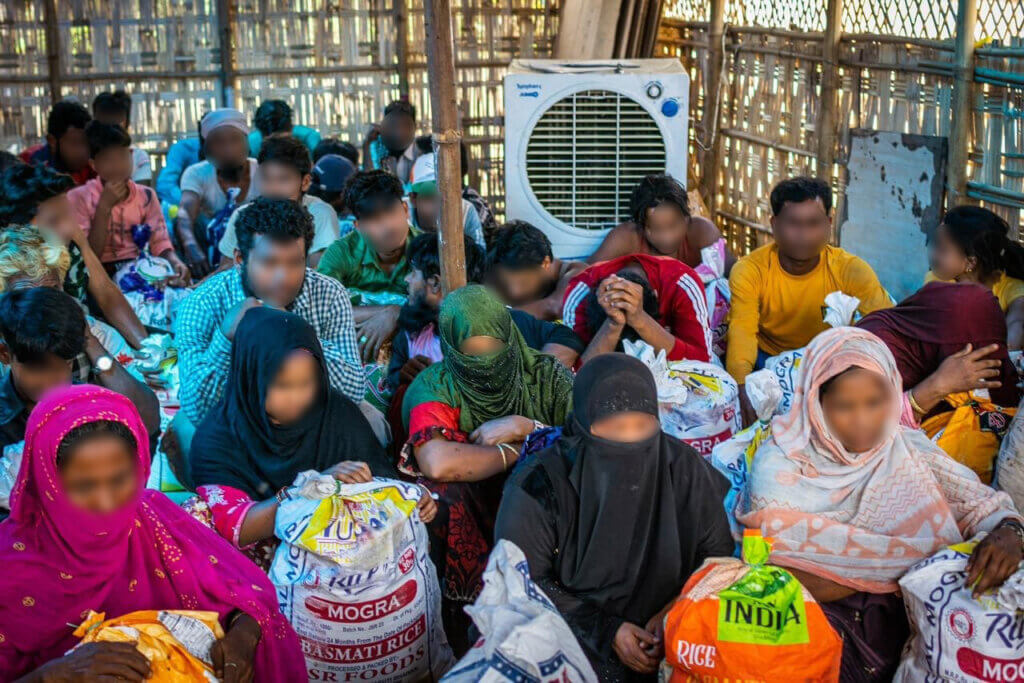
Thousands of Rohingya refugees living in India continue to face deep economic hardship and legal uncertainty, as the absence of formal refugee recognition restricts access to stable employment, financial services and basic protections. The situation has left many families dependent on irregular informal work while living under the constant risk of detention or deportation.
India is estimated to host around 40,000 Rohingya refugees who fled waves of violence and persecution in Myanmar’s Rakhine State. Many reside in makeshift settlements on the outskirts of cities such as New Delhi, Hyderabad and Jammu, where daily survival often depends on temporary labour in construction sites, scrap collection and street vending.
A report by BenarNews noted that the lack of government-recognized identity documents has effectively pushed most Rohingya refugees out of India’s formal economy. Without national identification systems such as Aadhaar, many refugees cannot secure regular employment, open bank accounts or access digital payment services that are now widely used across the country.
For individuals like Sohail Khan, a Rohingya refugee living in New Delhi’s Shaheen Bagh area, the barriers have reshaped life ambitions. After studying psychology, he once hoped to pursue a professional career but now runs a small handicraft stall following repeated job rejections due to the absence of official identification.
India does not have a national refugee law and is not a signatory to the 1951 Refugee Convention or its 1967 Protocol Relating to the Status of Refugees. As a result, Rohingya refugees largely depend on identification cards issued by the United Nations High Commissioner for Refugees, which often carry limited recognition in India’s employment and financial systems.
Humanitarian workers say the lack of legal status also increases the risk of labour exploitation. Rohingya labourers frequently report cases in which employers refuse to pay wages after discovering they lack official documentation, leaving them with little legal recourse.
Beyond economic difficulties, many Rohingya refugees also live with persistent fears of detention or deportation. Rights groups have documented several instances in which Rohingya individuals were detained by authorities despite holding refugee cards issued by the United Nations.
The challenges facing Rohingya refugees in India reflect a wider regional crisis. Following the mass displacement triggered by the 2017 Rohingya Exodus, more than one million Rohingya remain scattered across South and Southeast Asia, with the largest population living in Bangladesh.
Rights advocates say the absence of durable political solutions in Myanmar and the lack of coordinated regional protection frameworks continue to leave Rohingya communities across the region in a state of prolonged uncertainty and marginalization.
BOB Post