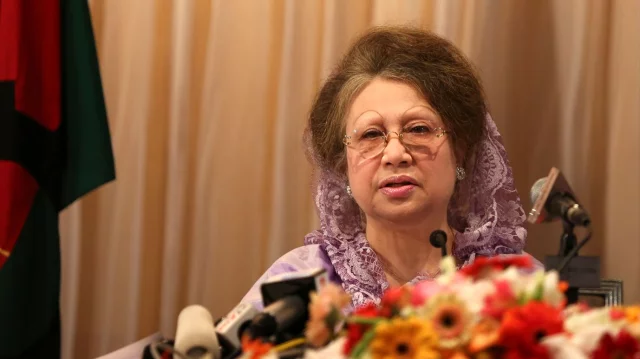
Begum Khaleda Zia, Bangladesh’s first woman prime minister and one of the most influential political figures in the country’s history, has died, drawing an outpouring of grief at home and abroad. Her death marks the end of a political era defined by mass movements, electoral battles and an unyielding struggle over the meaning of democracy in Bangladesh.
Khaleda Zia entered politics not by design but by circumstance. Following the assassination of her husband, President Ziaur Rahman, in 1981, she was thrust into the centre of national life at a moment of deep political uncertainty. A former homemaker with no prior political ambition, she gradually assumed leadership of the Bangladesh Nationalist Party (BNP) in the mid-1980s, transforming personal tragedy into a political mission.

Her rise coincided with the popular resistance against military ruler Hussain Muhammad Ershad. Khaleda Zia emerged as a leading figure in the pro-democracy movement, enduring repeated arrests and state pressure. The mass uprising of 1990, in which she played a decisive role, ended military rule and restored parliamentary democracy.
In 1991, Khaleda Zia led the BNP to victory in the general election and became Bangladesh’s first female prime minister. She would serve twice more, shaping national politics for more than a decade. Her time in office was marked by economic reforms, expansion of education and social programmes, and a fiercely competitive political environment dominated by rivalry with the Awami League. Together, the two parties defined Bangladesh’s democratic transition, often through confrontation as much as compromise.

Her administrations prioritized education, expanding access to schooling and fostering policies aimed at improving literacy rates nationwide. Agriculture, the backbone of Bangladesh’s economy, also received significant attention, with initiatives to boost productivity and rural livelihoods. Khaleda Zia’s leadership was characterized by efforts to balance economic growth with social welfare, and her governments made strides in infrastructure development, health services, and women’s empowerment.

The final phase of her political life was dominated by repression, illness and prolonged legal battles. Over the last 15 years, Khaleda Zia and the BNP accused successive governments of systematic political persecution, enforced disappearances, restrictions on civil liberties and the erosion of electoral credibility. She spent years under house arrest or in prison, her health deteriorating as her political space narrowed. To her supporters, she became a symbol of resistance against authoritarianism; to critics, a controversial but unavoidable figure in the nation’s history.

News of her death prompted widespread mourning. BNP Secretary General Mirza Fakhrul Islam Alamgir described her as a “leader who never compromised on democracy,” saying the country had lost a guardian of popular sovereignty. Condolences were also expressed by the chief adviser of the interim administration, who acknowledged her long role in shaping Bangladesh’s political journey.
International reactions reflected her regional and global stature. The United Nations paid tribute to her contribution to democratic politics. The United States and the European Union issued messages recognizing her role in Bangladesh’s modern political development. Indian Prime Minister Narendra Modi highlighted her contribution to India-Bangladesh relations, while China expressed deep sorrow, noting her significance in bilateral ties.
As Bangladesh reflects on her life, Khaleda Zia remains a towering and contested figure a leader who rose unexpectedly, governed decisively, and endured years of political hardship without relinquishing her claim to democratic legitimacy. Her death closes a defining chapter in the country’s history, leaving behind a legacy inseparable from the struggle for power, participation and democracy in Bangladesh.
BOB Post