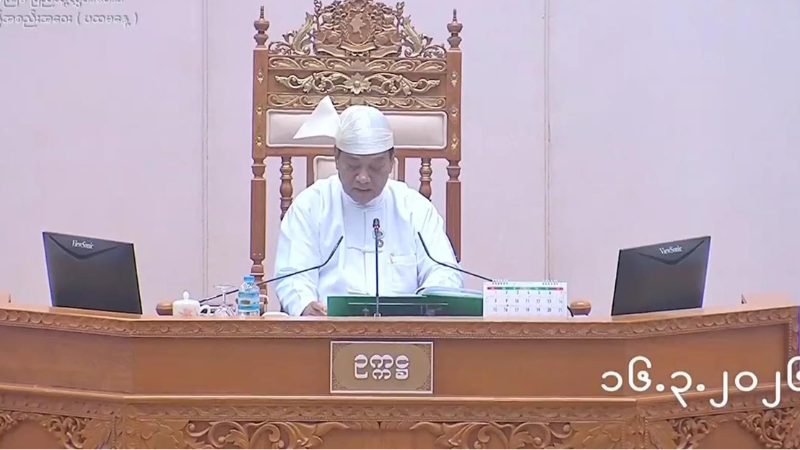
Military-backed politician Khin Yi is elected Speaker of Myanmar’s Lower House of Parliament on Monday as the junta-backed legislature convened for its first session in the capital Naypyitaw following widely criticized elections held in December and January.
Khin Yi, chairman of the military-aligned Union Solidarity and Development Party (USDP), secured a parliamentary seat from Zeyathiri Township in Naypyitaw in the regime-organized polls. A retired brigadier general and former immigration minister in the junta’s post-coup cabinet, he has long been regarded as a loyal enforcer for Myanmar’s military establishment.
During the opening session, lawmakers also appointed Maung Maung Ohn, another USDP figure who previously served as information minister in the junta’s cabinet, as deputy speaker of the Lower House.
The Lower House session marks the formation of a new parliament dominated by the pro-military USDP. Under Myanmar’s constitution, the armed forces automatically hold 25 percent of parliamentary seats through unelected military representatives, ensuring the military’s continued influence in legislative affairs.

Khin Yi has played a prominent role in Myanmar’s security apparatus for decades. As national police chief under former junta leader Than Shwe, he oversaw the violent suppression of the 2007 nationwide pro-democracy uprising known as the Saffron Revolution. He later served as immigration minister during the quasi-civilian government of Thein Sein.
Political observers say Khin Yi also played a key role in mobilizing pro-military rallies before and after the 2021 Myanmar coup d'état, which toppled the elected government of Aung San Suu Kyi. He also oversaw the continued house arrest of Suu Kyi during previous military rule.
According to reports by The Irrawaddy, the new Lower House is overwhelmingly controlled by USDP lawmakers and military-appointed representatives, reflecting the junta’s tight grip on the political system following the controversial elections widely rejected by opposition groups and pro-democracy activists.
The speaker election took place after lawmakers gathered in Naypyitaw around 10 a.m. for the chamber’s inaugural sitting. Analysts say the formation of the new parliament is part of the junta’s effort to institutionalize its rule while projecting a return to civilian governance despite ongoing conflict and international criticism.
BOB post