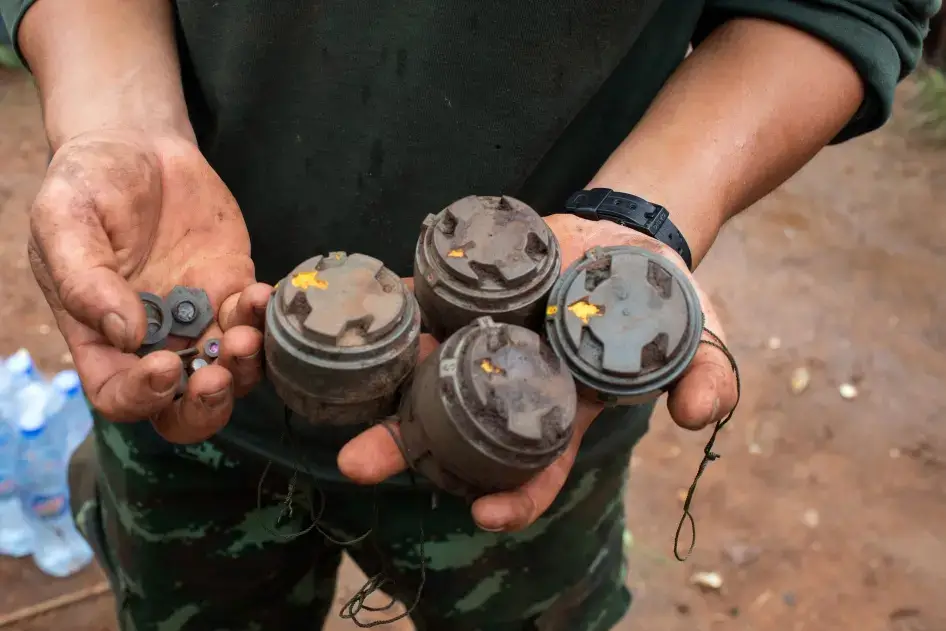
Villagers living along Bangladesh’s remote border with Myanmar are losing lives and limbs to landmines scattered across the hilly frontier, a deadly result of the ongoing conflict in Myanmar’s Rakhine State.
People from border hamlets near Naikhongchhari and Ghumdhum risk their lives every day while collecting firewood or grazing cattle. A single misstep can cost a leg or a life.
Ali Hossain, a 40-year-old villager, lost his leg last year while searching for wood deep inside the forest. He now depends on relatives to survive. We cannot even walk freely anymore, he said.
In nearby Ashartoli, another victim, Mohammad Abu Taleb, struggles on crutches after losing his foot to a mine explosion. His children had to quit school to help earn a living.
According to the Landmine Monitor report, Myanmar recorded over 2000 mine victims in 2024 — double the previous year’s figure. Bangladeshi authorities blame both Myanmar’s military and ethnic armed groups, including the Arakan Army, for planting explosives near the border.
Border Guard Bangladesh (BGB) officials have repeatedly urged Myanmar to halt such activities. These mines do not distinguish between soldiers and civilians, said Lt Col Kafil Uddin Kayes, a local BGB commander. It is pure cruelty.
The risk extends beyond the forest. Mines have washed up near streams and fields, endangering farmers and refugees. Aid workers say the real casualty numbers are likely higher than reported, as many injuries go unrecorded in remote areas.

Arakan Army Accused of Extortion and Abuses
While the landmine crisis worsens, the Arakan Army has come under increasing criticism for alleged extortion and abuses against Rohingya and other civilians in the border regions.
Rights groups say the armed group, which now controls much of northern Rakhine, has imposed illegal taxes, forced labor and travel restrictions on local people. Families have been made to pay bribes for movement permits, often costing several thousand kyats.
In some areas, Rohingya villagers have been ordered to hand over part of their harvest or livestock. Others were forced to work without pay or face punishment. Human Rights Watch recently reported that the Arakan Army’s behavior mirrors the same oppressive tactics once used by the Myanmar military.
Local reports say that in December, Arakan Army militias detained six fishermen, including Rohingya refugees and two Bangladeshi nationals, on the Naf River, further heightening tension along the frontier.
Bangladesh’s border security agencies are on alert as fighting across the frontier continues to push more displaced families toward the Cox’s Bazar region, already home to nearly one million Rohingya refugees.
Lives on the Line
The combination of landmines, extortion and displacement has made survival on the Bangladesh-Myanmar frontier increasingly fragile. Humanitarian groups are calling for immediate mine clearance, an end to civilian abuses and international action to protect those trapped between two warring sides.
For villagers like Ali Hossain, the appeals bring little comfort. We just want peace, he said quietly. We want to walk without fear.
BOB Post