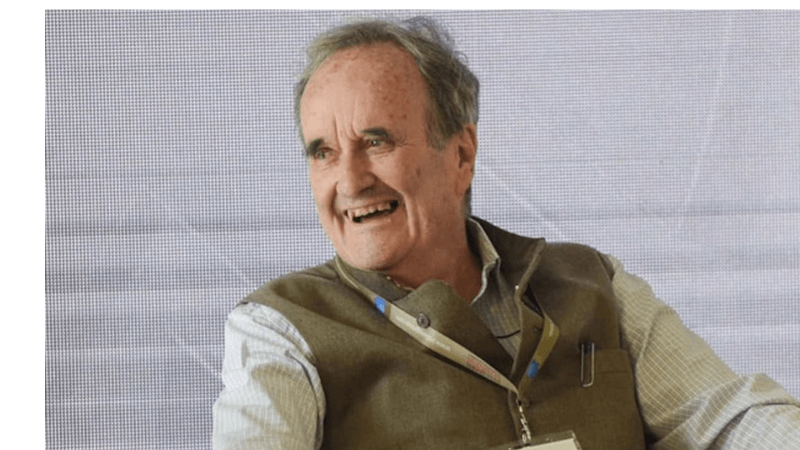
Sir Mark Tully, the legendary BBC journalist known across South Asia as the “Voice of India,” has passed away at the age of 90, leaving behind a legacy defined by courage, conscience, and an unwavering commitment to truth.
For Bangladesh, Sir Mark Tully was more than a foreign correspondent. During the dark days of the 1971 Liberation War, when Pakistan’s military sought to silence the reality of mass killings and destruction, Tully was among the very few Western journalists who broke through the wall of lies. At immense personal and professional risk, he exposed the atrocities unfolding in the East Pakistan, helping the world understand the scale and brutality of the genocide.
Arriving in East Pakistan in late April 1971 on one of the only occasions when the military regime allowed foreign journalists limited access,Tully travelled by road from Dhaka to Rajshahi. What he witnessed stayed with him for life: village after village reduced to ashes, a landscape marked by fear, loss, and suffering. His reporting, broadcast regularly on the BBC, carried rare credibility at a time when truth itself was under siege.

For countless Bangladeshis, the BBC meant Mark Tully. Families gathered around radios morning and evening, waiting for his calm, steady voice. To freedom fighters and civilians alike, his words offered recognition, solidarity, and hope. Through his reporting, international public opinion slowly shifted, and Bangladesh’s struggle found a moral echo beyond its borders.
In recognition of his role in supporting Bangladesh’s independence through truthful journalism, the government awarded him the Muktijuddho Maitri Sammanona in 2012, a tribute he deeply valued.
Born in Kolkata in 1935, a child of the British Raj, Tully spent most of his life in South Asia. Fluent in Hindi and deeply immersed in the region’s culture, he was never a distant observer. He reported not only on wars and assassinations, but on the everyday lives, beliefs, and struggles of ordinary people. From the Liberation War of Bangladesh to the Bhopal gas disaster, from Operation Blue Star to moments that tested India’s secular fabric, he bore witness with empathy and moral clarity.
Though he left the BBC in 1994 after publicly criticizing its leadership culture, his voice never faded. He continued to write, broadcast, and reflect often returning to questions of faith, justice, and human dignity. Honored by both Britain and India, including a knighthood and the Padma Bhushan, Tully remained modest, insisting that journalism was, above all, a public service.
Sir Mark Tully was a truth-teller in an age of noise, a bridge between worlds, and a rare Western voice that stood firmly with Bangladesh when it mattered most. His passing marks the end of an era, but his words, and the courage behind them, will endure.
BOB Post