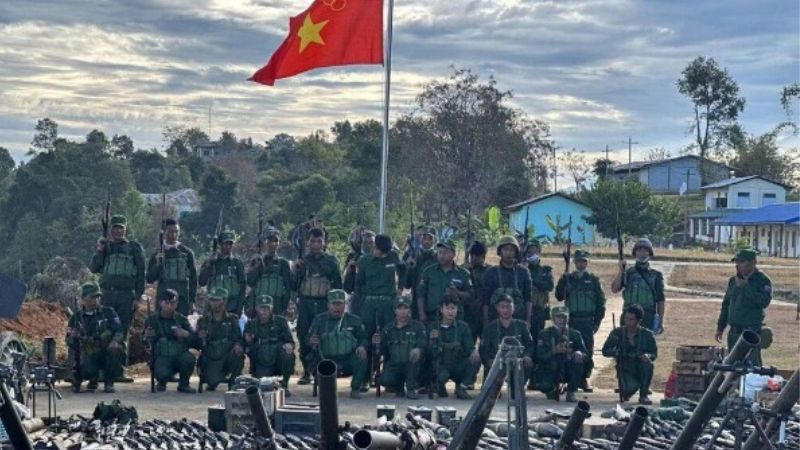
An alliance of Myanmar's ethnic minority armed groups announced on Sunday that they had agreed to a four-day ceasefire with the military junta in northern Shan state. This decision follows intense clashes in which the alliance seized territory along a strategic highway leading to China.
The region has experienced significant conflict since late last month, when the Three Brotherhood Alliance renewed its offensive against junta forces on the road to China's Yunnan province. This resurgence of violence disrupted a previously established truce brokered by Beijing in January, which had temporarily halted the alliance's earlier push.
Major-General Tar Bhone Kyaw of the Ta'ang National Liberation Army (TNLA) confirmed the ceasefire, stating, "We... showed cooperation with China by agreeing a four-day ceasefire in northern Shan" from 14-18 July. However, he noted that the agreement does not extend to the neighboring Mandalay region, where fighting continues between alliance members, other military opponents, and junta troops.
Efforts to reach a junta spokesperson for comment were unsuccessful.
China, a key ally and arms supplier to Myanmar's junta, also maintains relationships with ethnic armed groups controlling areas near its border. The ceasefire comes as China's top leaders convene for the Communist Party's secretive Third Plenum, an important political gathering.
In the latest series of clashes, the TNLA claimed to have captured two towns along the highway from Myanmar's second-largest city, Mandalay, to China's Yunnan province. One of these towns, Naungcho, is located approximately 50 kilometers from Pyin Oo Lwin, the site of the military's elite officer training academy. The town of Lashio, home to the military's northeastern command, has also seen intense fighting.
Recent battles have resulted in dozens of civilian casualties, with local rescue groups and the junta reporting numerous deaths and injuries. However, neither side has disclosed figures for their own losses.
Myanmar's border regions have long been the site of conflict between ethnic armed groups and the military, a struggle for autonomy and control over valuable resources dating back to the country's independence from Britain in 1948. Some of these groups have provided shelter and training to newer "People's Defence Forces" (PDFs), which emerged following the military's 2021 ousting of Aung San Suu Kyi's government.
In recent days, PDF fighters have engaged junta forces in Madaya township, north of Mandalay. Earlier this month, top junta general Soe Win visited China to discuss border security cooperation amid the ongoing conflict.
BOB Post