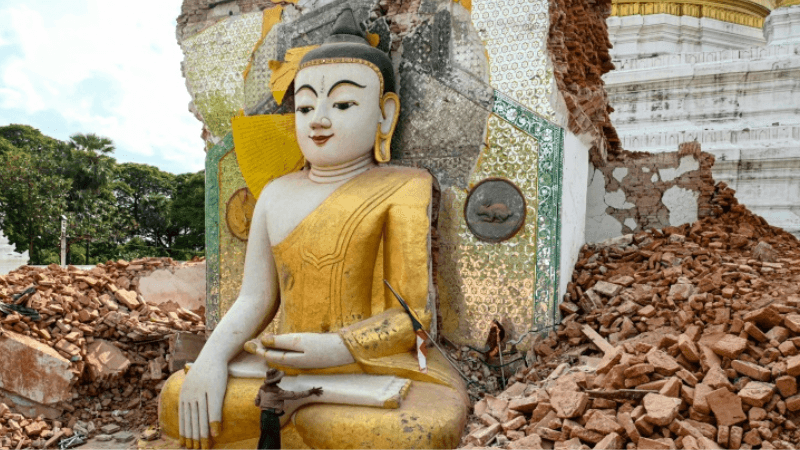
Myanmar’s already fragile economy has been dealt a devastating blow by the March 28 earthquake, which killed nearly 3,800 people and caused massive damage to homes, businesses, and critical infrastructure, according to a new World Bank report released Monday.
The country, reeling from four years of intense civil war following the 2021 military coup, now faces a projected economic contraction of 2.5 percent in the financial year ending March 2026. The World Bank attributes this decline “mostly to earthquake impacts,” estimating total output to be $2 billion lower than it would have been without the disaster.
“Production across all sectors has been disrupted by factory closures, supply chain constraints, labour shortages, and damage to infrastructure,” the report noted.

The tremor caused an estimated $11 billion in economic damage — equivalent to 14 percent of the country’s GDP — with Myanmar’s administrative capital Naypyidaw and the second-largest city Mandalay among the worst-hit regions.
According to the World Bank, both regions are expected to see economic output plunge by a third between April and September 2025 before modest recovery begins through reconstruction activities later in the year.

“The earthquake caused significant loss of life and displacement, while exacerbating already difficult economic conditions, further testing the resilience of Myanmar's people,” said Melinda Good, World Bank Country Director for Thailand and Myanmar.
The report comes as Myanmar remains gripped by a multifaceted civil conflict between the military junta and an array of opposition forces, including pro-democracy resistance groups and long-standing ethnic armed organizations. Though various sides have declared a ceasefire this month to facilitate aid delivery, heavy fighting continues across several areas of the country.
Economic instability has been further worsened by surging inflation, estimated at 34.1 percent in the 12 months leading to April 2025. The World Bank also reported that over 30 percent of the population lived in poverty in 2024, with more than three million people currently displaced due to conflict and disaster.
Despite the grim outlook, the Bank anticipates a limited rebound in the latter half of the financial year, driven by reconstruction spending and humanitarian assistance — provided security conditions permit access.
However, with the ongoing civil war showing little sign of abating, and critical infrastructure in ruins, the road to recovery remains uncertain for millions of Myanmar’s citizens.
BOB Post