The ceasefire brokered by China in northern Shan State fell apart on June 25, following complaints from the Ta’ang National Liberation Army (TNLA) about repeated attacks by Myanmar regime troops.
The ethnic Brotherhood Alliance, consisting of the Arakan Army, Myanmar National Democratic Alliance Army (MNDAA), and TNLA, had launched Operation 1027 against the regime in late October. This offensive paused when China brokered a truce in mid-January.
However, the TNLA resumed attacks in response to the junta’s continued ceasefire violations using drone and artillery strikes. The truce had been signed under Chinese pressure as Lashio, the capital of northern Shan and base of the junta’s Northeastern Command, came under siege. China was concerned about its investments being threatened if the fighting spread to Pyin Oo Lwin, home to key military academies.
China had hoped to use this truce to coax the regime into dialogue with opposition forces. Despite several attempts by China’s special envoy to Myanmar, Deng Xijun, to meet with jailed State Counselor Daw Aung San Suu Kyi, Myanmar's generals refused. In his recent visit to Naypyitaw, Deng met with foreign minister Than Swe rather than junta chief Min Aung Hlaing, indicating the informal nature of the meeting.
The resumption of TNLA attacks suggests they might have China's tacit approval. China appears to be teaching the regime a lesson after its refusal to engage in dialogue. This resumption might also be linked to the regime’s failure to curb an online scam industry near the border targeting Chinese citizens.
Regardless of China’s exact stance, it is clear that Beijing will not press the Brotherhood Alliance to halt the fighting. Despite five months of ceasefire, border trade has not resumed. The Brotherhood Alliance had previously seized most major border trade towns except Muse, and the junta is unlikely to reclaim them, minimizing China’s concerns about border conflicts.
On June 25, anti-regime forces attacked northern Shan’s Kyaukme and Nawnghkio and Mandalay’s Madaya and Mogoke townships, targeting junta outposts, police stations, and an air defense battalion. The resistance fighters have cut off Momeik (Momgmit), where a tactical command of the junta’s Northern Command is based. The Kachin Independence Army (KIA) and allies control another road to Momeik, effectively surrounding junta forces.
The anti-regime forces have also attacked Nawnghkio and Kyaukme, isolating Lashio. The regime might not risk sending reinforcements from Lashio to these towns, instead sending them from Mandalay, which also requires defense preparation.
Lashio-based Northeastern Command oversees 13 battalions and troops from three military operation commands. The 99th Light Infantry Division is based in Muse, while Mogoke houses troops from the Central Command and a tactical command. Additional units include artillery, combat-support, medical units, and training schools.
The regime’s reinforcements in Mandalay and Pyin Oo Lwin are limited to Central Command rearward troops and military academies. Reports indicate that family members of junta soldiers from Lashio were relocated to Hsipaw but are now trapped. An attempt to send reinforcements to Madaya was thwarted by ambushes.
With ground reinforcements, the regime can only provide air support. Troop shortages are evident, with only the 18th Military Operations Command (MOC) in eastern Shan State available. The regime cannot withdraw troops from Kachin and Rakhine states, where fighting is intense. It may consider transferring troops from Karenni State and Sagaing Region, potentially leaving those areas vulnerable.
Suspending Operation Aung Zeya in Karen State and using the 55th Light Infantry Division (LID) is another option, though this division has faced defeats. Overall, the regime can use troops from various MOCs in eastern Shan and Karenni State, and potentially the 55th LID from Karen State.
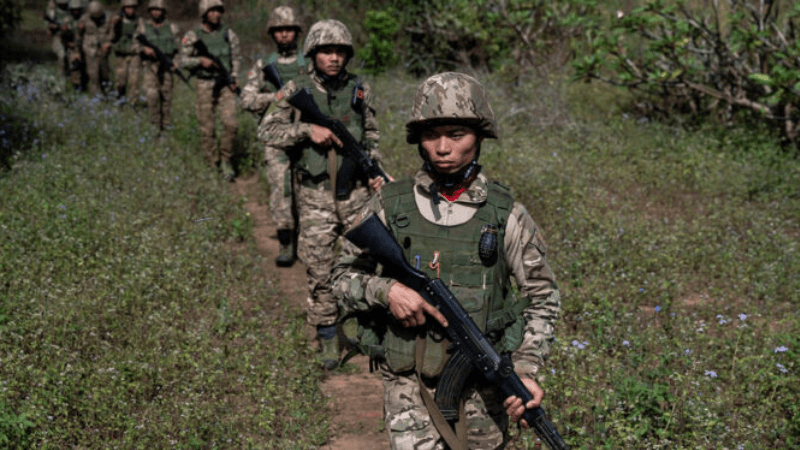
Currently, only the TNLA and allied People’s Defense Forces (PDFs) from Mandalay, Mogoke, and other areas are engaged in the operation. The ethnic Danu People’s Liberation Front (DPLF) has joined, with around 500 troops. The AA, MNDAA, and other allied forces have not yet joined the renewed fighting.
The TNLA has about 8,000 to 10,000 troops, with 3,000 involved in the current fighting. The AA and MNDAA have around 3,000 and 6,000 troops respectively in northern Shan State. With the AA and MNDAA still on the sidelines, it is uncertain if the renewed fighting represents a second phase of Operation 1027.
Junta positions in Mandalay and Pyin Oo Lwin are now under pressure. The complex chain of command in this area could favor anti-regime forces. The regime faces a dilemma: it risks losing towns if reinforcements are not sent soon, but withdrawing troops from other areas could create exploitable gaps.