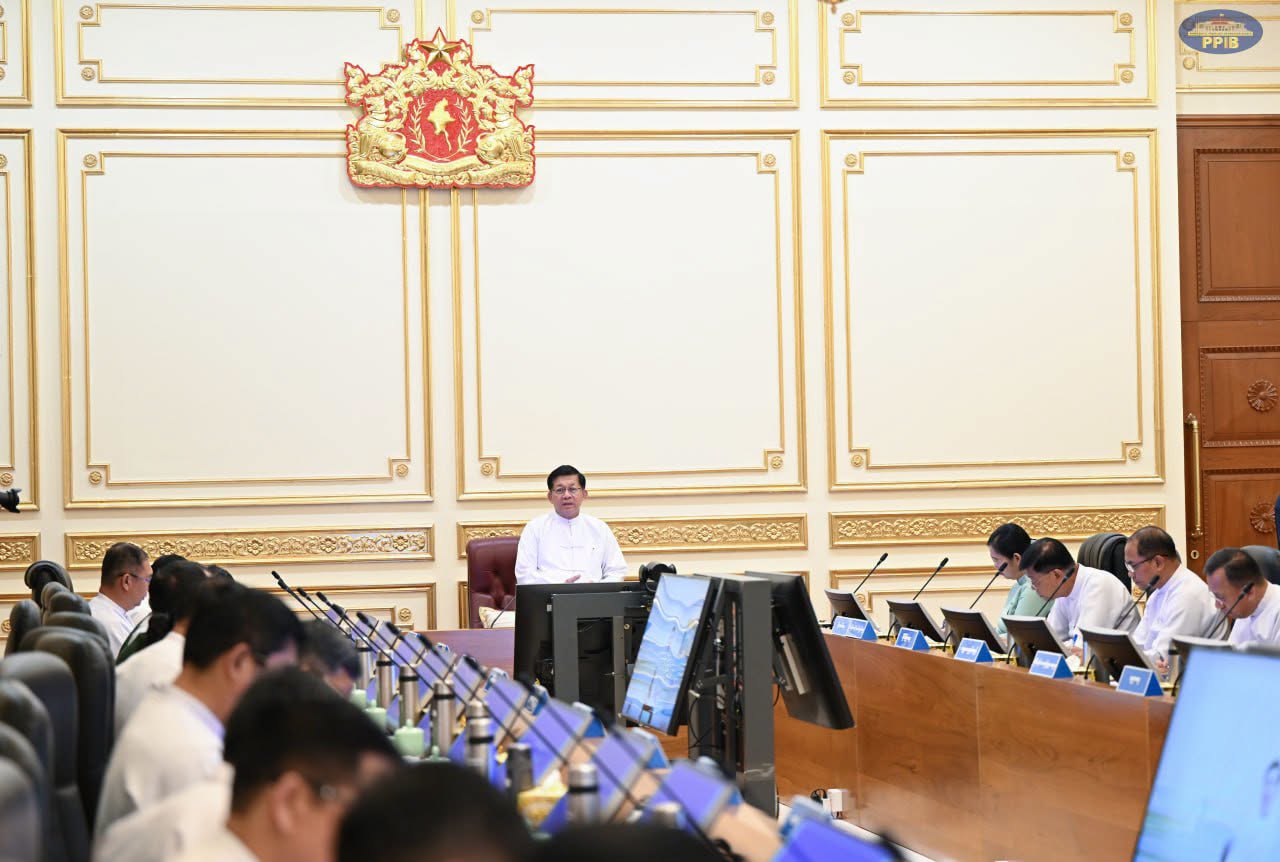
Myanmar junta chief Min Aung Hlaing has said the military could gradually reduce its presence in parliament only when the country no longer has any ethnic armed organizations (EAOs), reiterating the army’s long-standing justification for its continued political dominance.
Speaking to officers, soldiers, their families, and cadets in Pyin Oo Lwin on Thursday, Min Aung Hlaing claimed that the military has historically played a leading role in national politics due to “prevailing circumstances” and would continue to do so “until stability is achieved.” He insisted that the Tatmadaw’s involvement was necessary to ensure order and to implement state functions “systematically and correctly.”
He also said the army remains responsible for both national defense and domestic “stability operations,” adding that ongoing armed resistance would continue to be “eliminated.” According to Khit Thit Media, Min Aung Hlaing repeated similar talking points in recent internal meetings, framing the current nationwide conflict as justification for maintaining military political power.
Min Aung Hlaing stated that only when democracy “flourishes” and EAOs no longer exist would the military consider gradually reducing its constitutionally guaranteed parliamentary seats.
Meanwhile, the National Unity Government (NUG) has rejected the junta’s political roadmap, calling for the complete removal of the military from politics. The NUG has outlined six political demands: the end of military rule, full civilian oversight of all armed forces, permanent abolition of the 2008 Constitution, resistance to any attempt to revive it, drafting a new federal democratic constitution accepted by all stakeholders, and establishing a federal democratic union based on that charter. It also calls for justice and transitional justice for all victims of wartime abuses, including conflict-related sexual violence.
BOB Post