Calls for an investigation are mounting as fighters across multiple states allege the Myanmar military is deploying banned and restricted weapons such as white phosphorus.
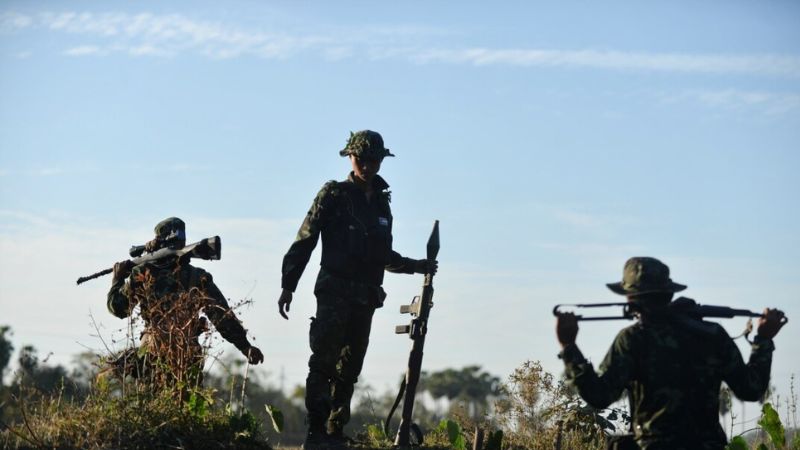
The attack once again, came from above. The Kachin resistance fighters barely heard the propellers before Myanmar military drones released their payload in northern Kachin State late April. "I fell to the ground when the bombs dropped," Aung Nge, a fighter with the Kachin People’s Defense Force (PDF), told Al Jazeera from an undisclosed location. "I didn’t lose consciousness. I was awake the whole time."
The drone attack seriously injured three men near the front line, where battles have intensified since last October. In critical condition, field medics sent the men to a hidden hospital deep in the jungle for treatment by professional doctors. Within a day, one soldier's condition inexplicably deteriorated. Another fighter, from the Kachin Independence Army (KIA), who had been injured in a separate drone strike, also died suddenly despite showing signs of recovery.
Aung Nge endured severe infections spreading across his body. Doctors noted rapid onset necrosis, an unusual effect for blast wounds. "After two days, all the wounds turned black with foul-smelling discharge," Dr. Soe Min, a veteran trauma doctor, told Al Jazeera. He had to amputate Aung Nge's arm to save his life.
Under the Chemical Weapons Convention (CWC), which Myanmar ratified in 2015, using chemical weapons is banned. These include substances like tear gas and herbicides. Myanmar has a history of allegations related to using such weapons, with claims against the Kachin in 2014 and the Karen in 2005, though neither was definitively proven.
The current regime, the State Administration Council (SAC), has already been accused of war crimes, including air attacks on civilians and burning villages. In March, the Pa-O National Liberation Army (PLNA) reported that the military used chemical weapons in Hsi Hseng, southern Shan State. In April, the "Joker Column" resistance group in Karen State alleged a "poison gas bomb" attack.
Human rights experts call for credible, independent investigations into these claims. David Scott Mathieson, an independent analyst, told Al Jazeera, "If substantial evidence is uncovered, it would need to go to the CCW committee, likely leading to calls for sanctions."
The UN's Independent Investigative Mechanism for Myanmar (IIMM) is also looking into these allegations. Meanwhile, the National Unity Government (NUG), composed of ousted politicians, said it is investigating the claims. "It's highly probable the military uses prohibited weapons to maintain dominance," said Nay Phone Latt, NUG spokesperson.
In April, the Karen National Liberation Army (KNLA) temporarily liberated Myawaddy, near the Thailand border. The SAC responded with air strikes. One local, Nay Min, recounted the experience: "We tried to escape, but the air strikes hit at least 80 times near us." After crossing into Thailand, several men fell ill from exposure to white smoke, experiencing burning eyes and disorientation.
Resistance groups claim the SAC is using incendiary weapons like white phosphorus. Phoe Thaike Maui, deputy commander of the Karenni Nationalities Defense Force (KNDF), told Al Jazeera, "These bombs create white smoke when there's nothing to burn. It reacts with oxygen, causing intense burning."
The Free Burma Rangers (FBR), a nonprofit providing medical aid, supports these claims. Founder Dave Eubank stated, "I have seen incendiary weapons used in Karen and Karenni states, including white phosphorus."
Back in the Kachin jungle, Aung Nge lies on a bamboo platform, blood seeping through his bandages. "I am feeling better, but I'm still suffering," he said. "We need help from the international community. They must take action. I want this situation over. I want to go home."
BOB Post