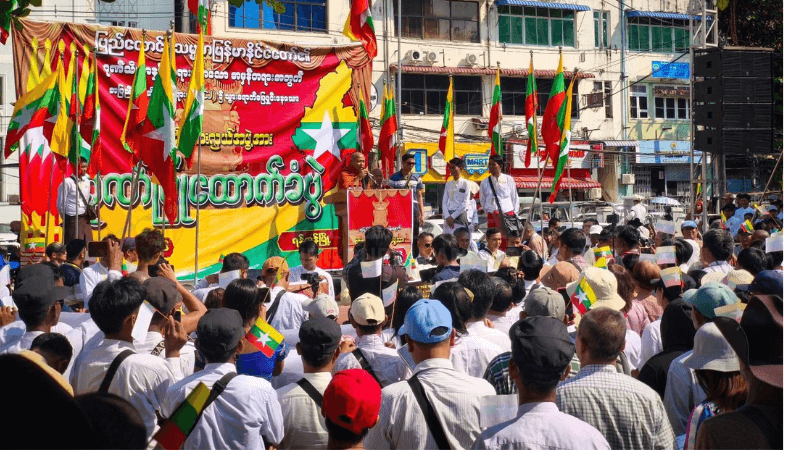
A large nationalist rally took place in downtown Yangon on Tuesday as hundreds of demonstrators gathered to oppose international genocide charges against Myanmar, in a rare protest allowed by the military authorities accused of committing the alleged crimes.
The rally comes as Myanmar defends itself before the International Court of Justice (ICJ), where it faces accusations that its 2017 military campaign against the Rohingya Muslim minority violated the UN Genocide Convention. The operation triggered the mass displacement of more than one million Rohingya, most of whom fled to neighboring Bangladesh.
Waving national flags and chanting slogans, protesters including ultra-nationalist activists and Buddhist monks in saffron robes danced to drums and displayed banners rejecting claims of ethnic cleansing. Speakers at the rally portrayed the ICJ case as an attack on Myanmar’s sovereignty rather than a pursuit of justice.

“We gather today for the dignity of our country, the truth for our country and for justice for our country,” nationalist figure Win Ko Ko Latt told reporters. “Myanmar is a land where loving kindness flourish. There is no such thing as genocide.”
According to an Irrawaddy report, the demonstration was closely monitored and approved by junta authorities, underscoring how public dissent is tightly controlled while nationalist expressions supporting the military narrative are permitted.
Myanmar’s leadership continues to deny the Rohingya’s ethnic identity, claiming they are migrants from Bangladesh and insisting the 2017 crackdown targeted insurgents. However, UN investigators and human rights groups have documented widespread killings, sexual violence, torture, and village burnings carried out by the military and allied militias.
The ICJ hearings began on January 12 and are expected to conclude later this week, though a final ruling could take months or even years. While the court lacks enforcement powers, a judgment against Myanmar would intensify its international isolation.
Several countries, including the United States, have already declared the military campaign a genocide, imposing sanctions on junta leader Min Aung Hlaing. Additional cases related to the Rohingya atrocities are also underway at the International Criminal Court and in Argentine courts under universal jurisdiction laws.
The case carries added historical weight as it originated during Myanmar’s brief democratic period. In 2019, then-leader Daw Aung San Suu Kyi personally appeared at The Hague to defend the military a move that drew global criticism and tarnished her reputation. Now 80, the Nobel laureate remains detained by the same generals who seized power in a 2021 coup.
BOB Post