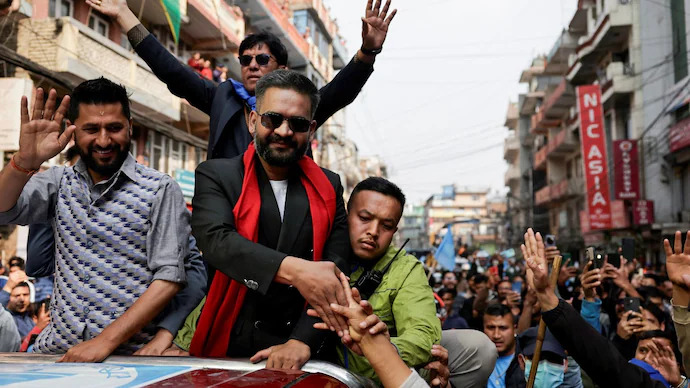
Nepal’s latest parliamentary election is ushering in a new generation of political leaders, marking one of the most significant shifts in the country’s political landscape in decades. Results from the March 5 polls show that a large number of newly elected lawmakers are under the age of 40, reflecting growing public demand for younger representation in a system long dominated by older political figures.
Out of 165 constituencies, 61 winning candidates about 37 percent are below 40 years of age. Political observers say the number could increase further once members are selected through the proportional representation system. The surge has largely been driven by the success of the Rastriya Swatantra Party (RSP), which fielded a significant number of young candidates and secured the largest share of the vote. Among the 61 young winners so far, 52 belong to the RSP. The Nepali Congress secured five seats with candidates under 40, while the Communist Party of Nepal (Unified Marxist–Leninist) (CPN-UML) has two such representatives and the Rastriya Prajatantra Party one.

The results represent a sharp contrast to recent years when Nepal’s political leadership was dominated by politicians in their 60s and 70s. In 2022, only around 11 percent of members of parliament were under 40. Analysts say the shift reflects frustration among younger voters who felt disconnected from a political establishment that failed to address issues such as employment, education, digital opportunities and governance reform.
Nepal is one of the youngest countries in South Asia, with a median age of about 26. Young people make up more than 40 percent of the population, yet they have historically had limited representation in political decision-making. The growing presence of younger lawmakers is therefore seen as narrowing the gap between the country’s demographics and its political leadership.
According to the The Kathmandu Post, the election results highlight a broader generational shift driven by youth-led activism and growing dissatisfaction with traditional parties. The newspaper noted that many of the newly elected representatives campaigned on promises of transparency, bureaucratic reform and modern governance, issues that have resonated strongly with younger voters.
Political observers also point to the role of social media and the rise of a new generation of politically active youth. The spread of digital platforms has transformed campaigning and public engagement, enabling younger candidates to connect directly with voters and mobilize support outside traditional party structures. This digital influence was particularly visible during recent youth-led protests against government policies, including attempts to restrict international social media platforms under the government of K. P. Sharma Oli.
Several emerging political figures have already captured public attention. Among them is Balendra Shah, a 36-year-old widely discussed as a potential future national leader, alongside younger activists and politicians such as Ranju Neupane and Prashant Upreti. Their rise signals what many see as the beginning of a new era in Nepal’s politics.
Despite the optimism surrounding the generational shift, analysts caution that youth alone will not guarantee effective governance. The new lawmakers now face the challenge of translating public expectations into concrete policy reforms, including tackling corruption, improving public services and addressing unemployment.
For many voters, however, the election has already broken a long-standing barrier. The rise of younger politicians suggests that Nepal’s political system may be gradually opening up to a generation that has long demanded a greater voice in shaping the country’s future.
BOB Post