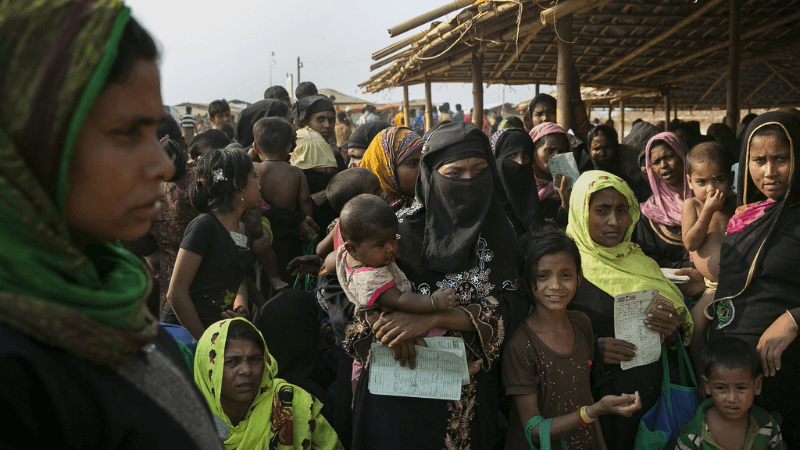
Hundreds of thousands of Rohingya refugees, who fled Myanmar to camps in Bangladesh nearly seven years ago, remain uncertain about returning home as global focus on their humanitarian crisis diminishes, activists said on Wednesday.
At an event organized by Refugees International, marking the upcoming seventh anniversary of the Myanmar military's August 2017 attacks on the Muslim ethnic minority, activists expressed concern that Rohingya may never return to Myanmar.
The 2017 atrocities, labeled a "genocide" by the United States in 2022, saw soldiers committing widespread rape, torture, and murder against the Rohingya population.
Since the violent crackdown, approximately 740,000 Rohingya have sought refuge in Bangladesh. Currently, about one million Rohingya live in refugee camps around Cox’s Bazar.
Tun Khin, president of the Burmese Rohingya Organization UK, highlighted that those Rohingya still in Myanmar's internally displaced persons (IDP) camps face targeted attacks by the military and fatalities from anti-junta forces amidst the ongoing civil war.
“In 2017, the international community was well aware, because people fled to Bangladesh and the media were there and were able to get that communication to everyone,” Tun Khin , noting that the initial media coverage spurred a rapid flow of resources to the refugees.
However, he added that there is now a “total blackout” due to the civil war, even as Rohingya are forcibly conscripted by Myanmar’s military junta to fight rebel forces opposed to the February 2021 coup. He suggested this conscription is partly to incite further ethnic tensions in Rakhine state, exacerbating the plight of displaced Rohingya families.
“No media is paying attention, and this is happening under the pretext of getting rid of the military dictatorship,” he said. “Of course, we want to see this military gotten rid of; we want to rebuild Rakhine state with all the minorities, but Rohingya lives should not be wiped out.”
'Genocide is Not Over'
Lucky Karim, a Rohingya living in Illinois, expressed her fears for the future of her people, as more Rohingya are killed or displaced within Myanmar, while those in Bangladesh are confined to refugee camps.
Karim explained that for those in the camps, surviving on $10 a month in food rations provided by the World Food Program, the prospect of resolution seems as distant as it was seven years ago.
“When we all fled to Bangladesh in 2017, the genocide was not over. It was just the beginning,” she said to Benar News. “People have limited access to transportation, limited access to education, and of course, the rations of food they get from WFP is never enough for every family.”
Karim emphasized the need for better opportunities for Rohingya to lead normal lives in Bangladesh, given the increasingly elusive possibility of returning to Myanmar.
“If we talk about solutions, livelihoods is the main one,” she said. “If you provide livelihood opportunities to families, they can make their own money, and it will help them to prevent human trafficking, child forced marriage and everything that is happening in the refugee camps.”
International Efforts
There are ongoing efforts to hold Myanmar accountable and press the junta to allow safe return of the Rohingya to their homes. The Gambia in 2022 brought a genocide case against Myanmar to the International Court of Justice (ICJ), supported by countries like the UK, Canada, and Germany.
Additionally, an Argentine federal court last year began hearing a criminal case against Myanmar’s military for its atrocities under the principle of “universal jurisdiction.”
However, these cases have their limitations, the forum heard.
“Many of the survivor community, they really just want to go home, right? They want to go to their homes, and they want to go home as soon as possible. And some of these processes aren’t going to really achieve that,” said Arsalan Suleman, a Washington-based lawyer representing The Gambia in its ICJ case against Myanmar.
“The [Argentine] criminal processes are meant to put people in jail and have criminal accountability,” he said. “That, directly is not going to get some of the people out of the camps and into their homes.
“Similarly for the ICJ case, the Gambia has asked the court to order Myanmar to repatriate the refugees and allow them to go back to their homes, but we are not sure exactly what the court will order,” he said to Benar News.
With the case still pending, it may be too little, too late.
For Karim, if Rohingya cannot leave the camps in Bangladesh and safely return to their homes in Myanmar soon, the final stage of the genocide might be imminent.
“If we don’t have any single member in Rakhine state from our community, from our religion or from our ethnicity,” she said, “I just fear that Rohingya will be disappeared from this world very soon.”
BOB Post