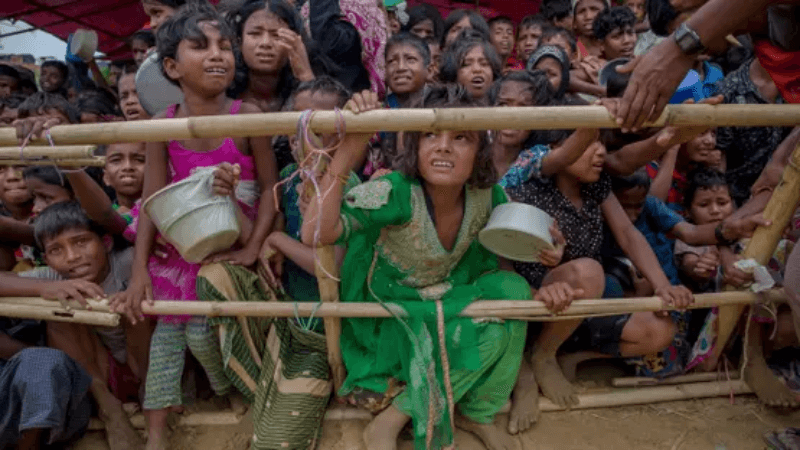
Severe foreign aid cuts imposed this year by U.S. President Donald Trump, along with funding reductions by other donor countries, have crippled child protection, education and youth programs in Bangladesh’s Cox’s Bazar, home to about 1.2 million Rohingya refugees from Myanmar. The cuts have forced thousands of schools and training centres to shut down, exposing children to exploitation, trafficking, child marriage and forced labour.
According to a UNB report, humanitarian agencies operating in the camps say the sudden funding shortfall has dismantled one of the few protective barriers Rohingya children had — access to education and safe spaces. Aid workers warn that the closures have left children idle and vulnerable, while families facing extreme poverty are being pushed into desperate decisions.
Hasina, 17, said the learning centre she attended had protected her from early marriage and abuse. When funding for the school was cut in June, her education ended abruptly and she was married off. She said her husband began beating and sexually abusing her soon after. “If the school hadn’t closed, I wouldn’t be trapped in this life,” Hasina said, adding that she once dreamed of becoming a teacher.
UNICEF has reported a sharp rise in child abuse and exploitation in the camps this year. Abductions and kidnappings have quadrupled to 560 cases, while 817 children were recruited or used by armed groups operating in and around the camps. Verified child marriages increased by 21% and child labour by 17% compared to the previous year, though agencies say the real figures are likely far higher due to underreporting.
The UNB report also noted that with learning centres closed, children have lost safe spaces to learn and play, making them easy targets for traffickers who exploit hunger, fear and hopelessness. Aid workers say traffickers are increasingly active in the camps, offering false promises of work or education abroad.
Ten-year-old Mohammed Arfan now spends his days selling snacks instead of attending school, while 13-year-old Rahamot Ullah collects plastic from sewage canals to earn money for private lessons his family cannot afford. Both boys told aid workers they want to return to school but see no way forward under the current conditions.
Humanitarian organisations warn that the crisis is likely to worsen next year. Save the Children has secured only about one-third of its funding target for 2026, putting at least 20,000 children at risk of losing access to education. UNICEF has managed to reopen some learning centres using remaining funds, but many facilities remain closed and face permanent shutdown without renewed donor support.
Beyond education, the aid cuts have deepened hunger, health risks and unsafe living conditions across the camps. Desperate families are increasingly sending children on perilous journeys abroad, often through traffickers. In one case cited by aid workers, a 13-year-old boy was trafficked to Malaysia, forcing his father to scramble to raise money to pay a ransom for his release.
Experts and humanitarian workers told UNB that the funding reductions have already destroyed lives and futures, undoing years of progress in child protection. “Schools were the last line of defence,” one aid worker said. “Without them, children are being pushed into labour, trafficking and forced marriage, with little hope of returning to the education and protection they lost.”
BOB Post