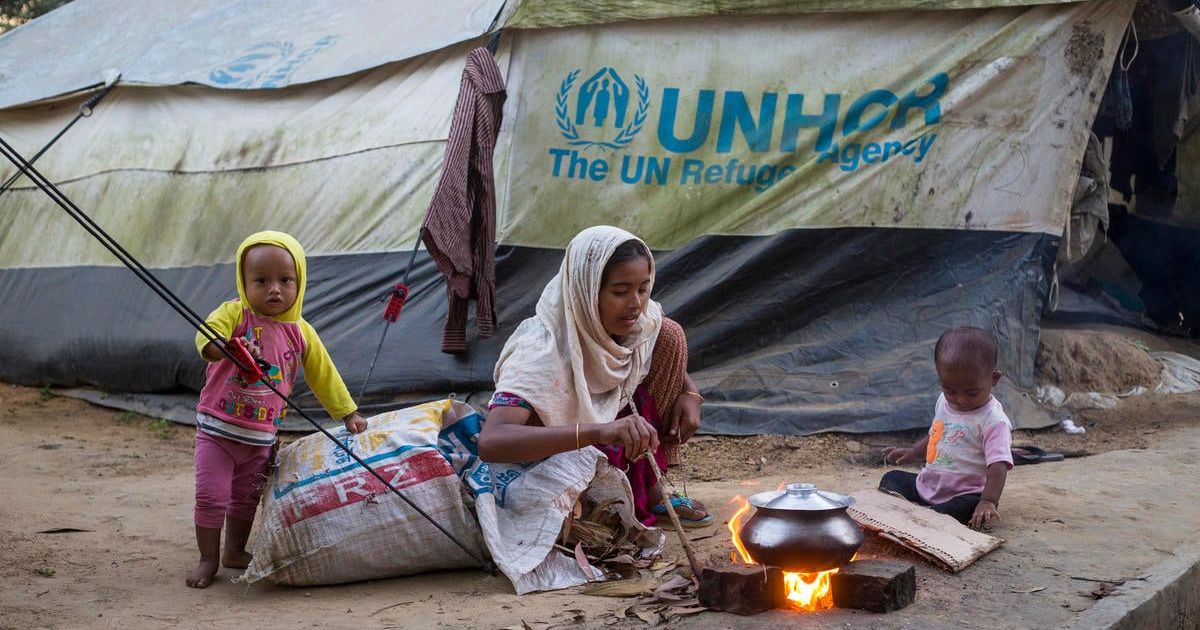
The United Nations expressed concern on Friday (23 August) about the potential for a recurrence of the 2017 atrocities committed against the Rohingya community in Myanmar's Rakhine State. The current situation in Maungdaw and Buthidaung has become dire. This time, Myanmar's powerful rebel group Arakan Army is cracking down on rohingyas. Again, killings are going on there, houses are being burnt. Rohingya women, men and children are again waiting at the Bangladesh border in search of safe shelter. Human rights activists define the situation as another 'Genocide'.
UN Human Rights Chief Volker Turk voiced deep concern over the rapidly worsening situation across Myanmar, particularly in Rakhine, where reports indicate that hundreds of civilians have been killed while attempting to flee the ongoing conflict.
Since November, Rakhine has been engulfed in violence following an attack by the Arakan Army (AA) on Myanmar’s junta, effectively ending a ceasefire that had largely been in place since the 2021 coup.
Turk condemned both the Myanmar military and the AA for human rights abuses against the Rohingya, including extrajudicial killings, abductions, and indiscriminate bombardments of towns.
The AA claims to be fighting for greater autonomy for the ethnic Rakhine population in the state, which is also home to approximately 600,000 Rohingya Muslims.
Hundreds of thousands of Rohingya fled Rakhine in 2017 during a crackdown by the military that is now the subject of a United Nations genocide court case.
“Thousands of Rohingya have been forced to flee on foot, with the AA herding them repeatedly into locations that offer scant safe haven,” Turk said in a statement.
“As the border crossings to Bangladesh remain closed, members of the Rohingya community are finding themselves trapped between the military and its allies and the Arakan Army, with no path to safety.”
Bangladesh is now home to more than 1.5 million Rohingya refugees.
“This month marks seven years since the military operations which drove 700,000 across the border into Bangladesh. Despite the world saying ‘never again’, we are once more witnessing killings, destruction and displacement in Rakhine,” Turk said.
A statement by UN Secretary-General Antonio Guterres called on all parties “to end the violence and ensure the protection of civilians”.
He urged the strengthening of “regional protection efforts, to provide access to conflict-affected communities and further support host countries”, especially in Bangladesh.
Turk said parties to the armed conflict were denying responsibility for attacks against the Rohingya, which “stretches the bounds of credulity”.
The UN Human Rights Office reported that the junta and AA have both committed serious human rights violations and abuses against the Rohingya.
These include extrajudicial killings, some involving beheadings; abductions, forced recruitment, indiscriminate bombardments of towns and villages, and arson attacks.
“Both the military and the AA bear direct responsibility for the human tragedy that is unfolding in Rakhine,” said Turk.
“These atrocities demand an unequivocal response: those responsible must be held accountable, and justice must be pursued relentlessly.
“Recurrence of the crimes and horrors of the past must be prevented as a moral duty and a legal necessity.”
Turk called on both parties to cease attacks on civilians and urged ASEAN to take measures to protect the Rohingya.
Guterres voiced hope “for sustainable peace and national reconciliation that are important steps to create conditions conducive to the voluntary, safe, dignified, and sustainable return of the Rohingya people to Myanmar.”
The recent exodus of Rohingya started due to fighting in and around the town of Buthidaung, about 25 kilometers east of Maungdaw. Arakan Army captured the town of Buthidaung after intense fighting. During the battle, the Arakan Army targeted the Rohingya population. According to various media sources, many died and at least 40,000 Rohingya have been displaced by the Arakan Army attack. Last month, hundreds of thousands of Rohingya fled to neighboring Bangladesh for safety from the ongoing conflict. However, Bangladesh is not interested in sheltering any more refugees.
Accusations against the Arakan Army are mounting as reports surface that Rohingya are being forcibly recruited into the army by the Myanmar junta and sent to counter-insurgency operations in Rakhine villages. Human Rights Watch estimates that more than 1,000 Rohingya have been forcibly recruited into the army since February.
The American press has highlighted these facts in a report of the New York Times.
Again, the number of these killings is not known, but the human rights activists admit that the Rohingyas have been victims of another genocide. Their fear is that if the world ignores them like this, then these unfortunate Rohingyas will wait for the third and fourth genocide. Even if they look human, they will not become human.
BOB Post