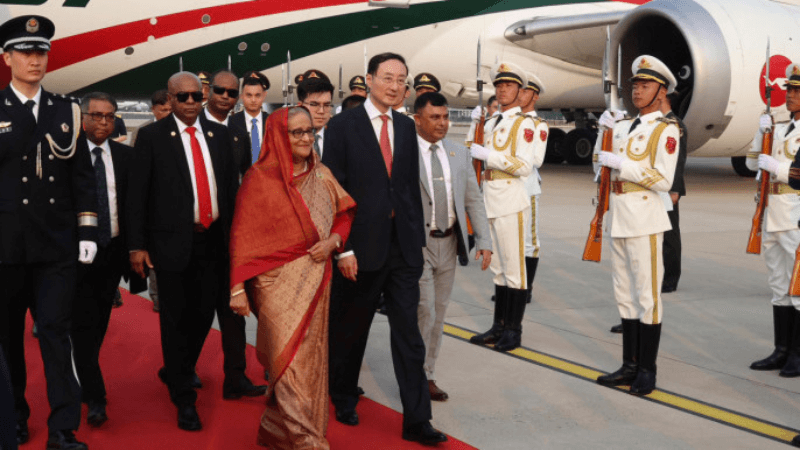
On Wednesday, Chinese President Xi Jinping and Premier Li Qiang will meet with Prime Minister Sheikh Hasina, indicating a new chapter in the developing partnership between Bangladesh and China.
Because of China's sponsorship of major infrastructure projects like the Padma Rail Bridge and Bangabandhu Tunnel, as well as Bangladesh's involvement in the Belt and Road Initiative (BRI), the bilateral connection between the two countries has greatly deepened during the past ten years.
But the talks that will take place in Beijing's Great Hall will go beyond bilateral ties; in the face of evolving regional and global dynamics, geopolitics and geo-economics will be the main agenda items.
According to diplomatic sources, the presidents' discussions would prioritize economic cooperation. A possible declaration that the two would now be a "close strategic partnership" could signal a change in direction. Beijing can also discuss its part in the significant economic growth in the southern part of Bangladesh.
Following her recent trip to India, Prime Minister Hasina is now visiting China. China's proposal for the highly debated Teesta River project is presently on hold since India intends to send a technical team and has expressed interest in transboundary river management.
China has expressed great interest in Bangladesh's participation in the Global Development Initiative (GDI), a major initiative by President Xi Jinping, in addition to the Teesta project. During Hasina's visit, both nations were ready to sign a memorandum of understanding (MoU) on GDI; however, Bangladesh withdrew from the project in late June.
Prime Minister Hasina arrived in Beijing on Monday afternoon. On Wednesday morning, she is expected to have a bilateral summit with Premier Li Qiang and then meet with President Xi Jinping in the afternoon.
State Minister for Power, Energy, and Mineral Resources Nasrul Hamid, State Minister for Posts, Telecommunications, and Information Technology Zunaid Ahmed Palak, State Minister for Commerce Ahasanul Islam Titu, Foreign Minister Hasan Mahmud, Advisor on Private Industry and Investment Salman F Rahman, and Finance Minister AH Mahmood Ali are among her 91-person entourage. The prime minister is accompanied by a business delegation consisting of fifty-nine individuals.
Future of the GDI
China urged Bangladesh to join the Global Development Initiative (GDI) and the Global Security Initiative (GSI) during the visit of Chinese Foreign Minister Wang Yi to Dhaka in 2022. Bangladesh demonstrated interest in the GDI but chose to postpone signing any agreements despite expressing reluctance to join the GSI. China invited Bangladesh to a ministerial conference last year and hoped that Bangladesh would at least join the GDI associate forum. For strategic considerations, Bangladesh did not, however, sign a joint statement following the conference.
A senior government source indicated that China could use the $5 billion loan as leverage with the GDI. Dhaka may at the last minute declare its participation in the GDI by a joint statement if China accepts the conditions established by Bangladesh.
According to diplomatic experts, Bangladesh has little difficulty joining the GDI because it is essentially a development-focused project. It is unclear, though, to what degree Bangladesh will be able to work out advantageous terms in order to obtain loans from China.
Teesta Not on the Agenda
Since 2011, there has been no progress on the Teesta water-sharing agreement. The deal was supposed to be signed in 2017 by Indian Prime Minister Narendra Modi and Bangladeshi Prime Minister PM Hasina, but that hasn't happened yet. Bangladesh carried out an assessment for a massive project on the Teesta River in 2019 and suggested Chinese funding, to which China first gave its approval. However, the project has stagnated because to India's concerns about China's involvement.
China had anticipated that the project would go forward following Bangladesh's most recent general election, but in recent months, talks have stalled. This visit is not planned to discuss the Teesta water management issue.
Hasan Mahmud, the foreign minister, stated that only if China brings up the Teesta problem would it be discussed. He continued by saying that Bangladesh is thinking about an Indian suggestion for managing transboundary rivers.
Fate of China's Loans
Securing a $5 billion loan from China is Bangladesh's top objective, while China concentrates on the Teesta and GDI. According to diplomatic sources, the interest rate is not the main topic of conversation; instead, the loan repayment length and grace period are. Whereas China wants a 20-year payback period with a 5-year grace period and a 1 percent interest rate, Bangladesh wants a 30-year repayment period with a 10-year grace period. China is looking for a 2 percent interest rate, provided that the loan parameters meet Bangladesh's preferences. Though a conclusion to these debates has not yet been found, progress may be made through political level negotiations.
Compared to loans from the World Bank, Asian Development Bank, and other development agencies, which have repayment lengths of 30 to 40 years, Chinese loans usually have shorter repayment periods. Because of the higher installment payments, pressure is created.
M Humayun Kabir, the president of the Bangladesh Enterprise Institute (BEI) and a former diplomat, pointed out that China is facing pressure from around the world over the One China Policy, trade, Taiwan, and the South China Sea. As a result, China would actively pursue Bangladesh's cooperation, broadening the PM's visit's focus beyond personal matters. Bangladesh must contend with pressure from abroad while striking a balance between its strategic alliance with China and its economic objectives.
BOB Post