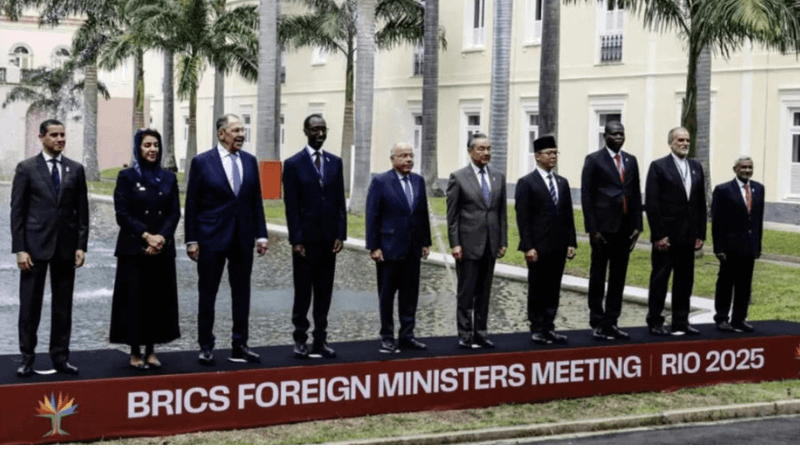
In a pointed show of unity against growing global trade tensions, foreign ministers of the BRICS bloc—comprising Brazil, Russia, India, China, South Africa, and five recently inducted nations—gathered in Rio de Janeiro this week and jointly condemned the resurgence of trade protectionism, in an implicit rebuke of U.S. President Donald Trump's aggressive tariff policies.
At the forefront of the criticism was Brazil’s Foreign Minister Mauro Vieira, who, speaking on behalf of the host nation, emphasized that the now 11-member BRICS grouping had reached an "absolute consensus" in rejecting protectionist measures. While the ministers stopped short of directly naming President Trump, the context was unmistakable.
Since his return to the White House in January 2025, Trump has reignited trade tensions by slapping a sweeping 10 percent tariff on imports from dozens of countries. China, a key member of BRICS, has been hit particularly hard, with tariffs on some of its exports soaring to 145 percent. Beijing has retaliated with duties of up to 125 percent on American goods, creating a climate of escalating trade conflict.

The BRICS meeting, held just three months ahead of the high-level leaders’ summit, reflects a growing alignment among non-Western powers on economic sovereignty and resistance to Western economic coercion. “The world cannot afford a return to protectionism and trade wars,” said Vieira. “The BRICS nations stand for multilateralism, fair trade, and mutual growth.”
The group, originally founded in 2009 by Brazil, Russia, India, and China, has recently expanded to include Egypt, Ethiopia, Indonesia, Iran, Saudi Arabia, South Africa, and the United Arab Emirates, boosting its global influence and economic clout. Together, BRICS nations represent over 40% of the global population and a significant share of world GDP.
Observers view President Trump’s tariffs as a litmus test for the bloc’s political resolve and economic cohesion. With Washington signaling no intention to back down, the world watches to see whether BRICS will retaliate with coordinated countermeasures or seek alternative trade arrangements that bypass the U.S.-led system.
While no formal joint communiqué was released, diplomatic sources confirmed that discussions also touched on the development of a BRICS common currency initiative, deepening south-south cooperation, and reducing dependency on Western-dominated financial systems.
As trade tensions mount, the BRICS bloc appears poised to use its upcoming summit as a platform to project a unified vision of economic multipolarity—one that challenges the dominance of the U.S. and reinforces the global south’s role in shaping the 21st-century economic order.
Bob post