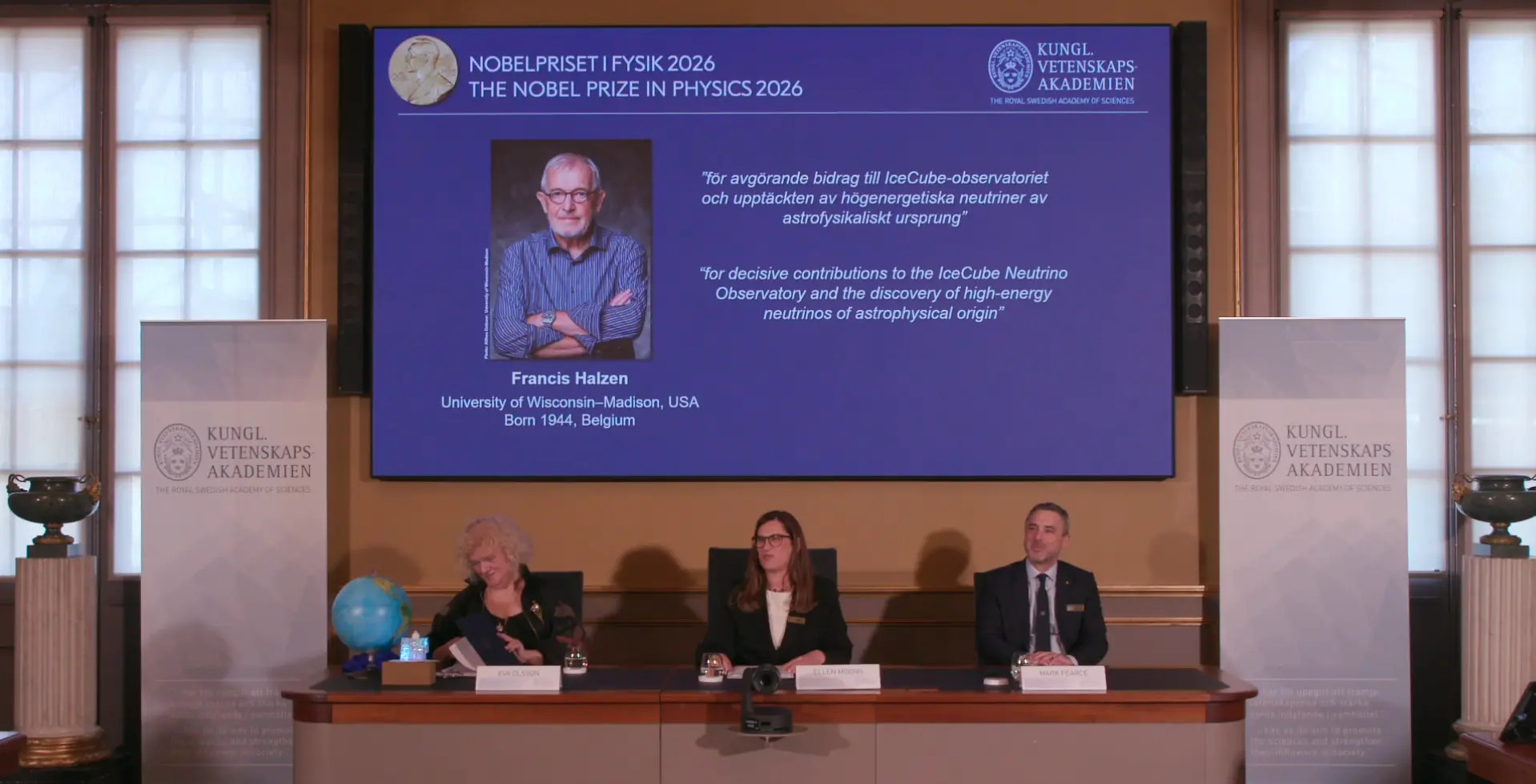
Belgian physicist Francis Halzen has been awarded the 2026 Nobel Prize in Physics for pioneering a vast neutrino observatory buried deep beneath the ice at the South Pole, opening a new window into some of the universe’s most powerful and mysterious events.
The Royal Swedish Academy of Sciences announced the award in Stockholm on Tuesday, recognizing Halzen’s leading role in developing the IceCube Neutrino Observatory in Antarctica.
The massive detector uses the clear Antarctic ice to track elusive subatomic particles known as neutrinos. Scientists say the particles can travel enormous distances through space and matter largely undisturbed, carrying information from regions of the universe that conventional telescopes cannot easily observe.
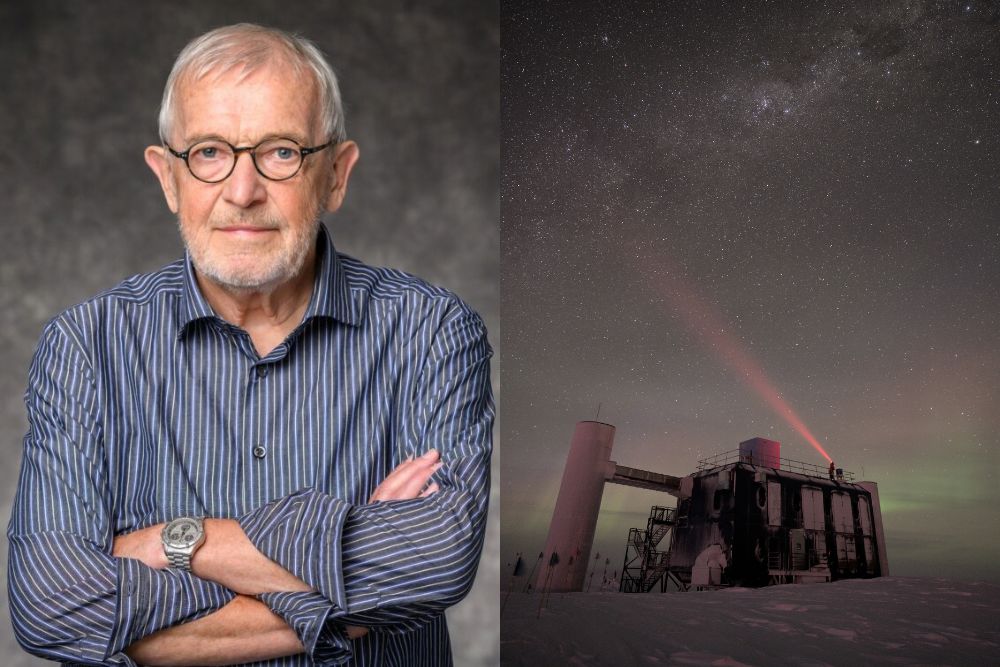
The 82-year-old Halzen said he was surprised by the honour, despite previous speculation that he could receive the prize.
“It was a great surprise, and I obviously didn’t expect it,” he told the Nobel committee by phone from Italy during the announcement.
He joked that he was currently working on a new research proposal and hoped the Nobel Prize would help secure approval for it.
Halzen first proposed the IceCube project in 1988, envisioning the Antarctic ice as a natural detector. When a neutrino occasionally collides with an atomic nucleus, it produces a tiny flash of light. Thousands of sensors embedded deep in the ice can detect and record those flashes.
According to Al Jazeera, the observatory has transformed the study of high-energy particles by allowing scientists to trace neutrinos back to distant cosmic sources. Researchers say this could shed light on exploding stars, active galaxies and the role of black holes in shaping the universe.
Neutrinos are electrically neutral and have extremely small masses, allowing them to pass through planets, stars and even human bodies with little interaction. Scientists estimate that trillions of solar and cosmic neutrinos pass through each person every second.
The IceCube experiment has therefore given researchers a new way to study the cosmos, particularly phenomena that are difficult to observe using light alone.
Nobel committee member Eva Olsson described neutrinos as messengers from the cosmos that have helped scientists investigate distant galaxies and the violent processes taking place within them.
The award also recognises the collective effort behind IceCube, which involved hundreds of scientists and engineers. Researchers say Halzen's original vision was crucial to turning the idea of using Antarctic ice as a giant particle detector into reality.
Last year's Nobel Prize in Physics went to John Clarke, Michel Devoret and John Martinis for experiments demonstrating quantum effects in electrical circuits.
The 2026 Nobel Prize in Chemistry is due to be announced on Wednesday, with the remaining prizes to follow later in the week. The laureates will formally receive their awards at ceremonies on December 10, the anniversary of Alfred Nobel's death.
BOB Post