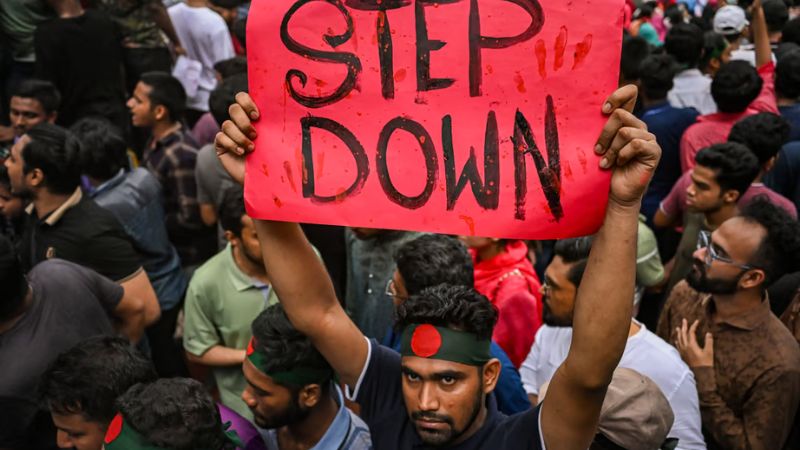
Bangladesh is currently going through a delicate political transition, with the world keeping a close eye on the nation following Sheikh Hasina's resignation and an interim administration headed by Nobel laureate Muhammad Yunus was formed. Recognizing Bangladesh's vital juncture, the international community has shown a strong desire to collaborate with the incoming administration.
There was widespread disorder and a breakdown in law and order during Bangladesh's three chaotic days without a functioning government. Now that an interim administration has been established, there is cautious optimism that stability will soon return. Our ground reporters have informed of the situation stabilising and positive reform being brought to all sectors of the country. The necessity of establishing responsibility and reestablishing order in light of the unfortunate deaths that have occurred during the recent unrest has been emphasized by world leaders.
The economy, which had been in freefall for the last month, is now steadily back on a consistent rise. A severe decline in July made the country's ongoing economic problems frightening but with time the economy will be able to bounce back. Recognizing these difficulties, the international community has expressed that it is prepared to assist.
The Dhaka Stock Exchange (DSE) benchmark index reached a five-month high today, surpassing the 6,000-point mark for the fourth consecutive day. Rubayat-Ul Islam, chairman of the Bangladesh Securities and Exchange Commission, resigned five days after the fall of the Awami League government. Investors are optimistic about the political changes and are betting on large-cap and blue-chip stocks, hoping for better governance in the market. Stocks like Islami Bank Bangladesh, Grameenphone, BRAC Bank, BAT Bangladesh, and others performed well today. Islami Bank Bangladesh, Grameenphone, BRAC Bank, and BAT Bangladesh saw double-digit growth. The DSEX index rose by 91.09 points to close at 6,015, while other indices also showed increases. Turnover increased by 25.12 percent to Tk 2,010 crore. AB Bank was the top gainer, while Crystal Insurance Company experienced the most significant loss. The Chittagong Stock Exchange (CSE) also saw a positive trend with the All-Share Price Index rising by 2.87 percent.
The interim government will take action as per the law if any official is involved in any irregularity, but its immediate task is to bring normalcy to the economy, said Salehuddin Ahmed, finance and planning adviser.
"Immediately everything, including the Bangladesh Bank, will be on. Banks and ports will operate. Economic activities will be on as per the normal process," he said after a meeting with the secretary-level officials of the finance and planning ministries at the secretariat in Dhaka.
European Union officials, who oversee a robust $24 billion trade relationship with Bangladesh, have already expressed their eagerness to engage with the new leadership. They view this period as a pivotal moment, not only for the government but also for the people of Bangladesh, particularly its youth, who have been at the forefront of demanding change. The EU’s willingness to continue and even strengthen commercial ties underscores the importance of international cooperation in ensuring a smooth transition.
While the global response has been largely positive, there is a shared understanding that the heavy lifting must be done by the Bangladeshi people and their leaders. The interim government, led by Yunus, is expected to steer the country toward a more democratic future, a task that will require both internal resolve and external support.
Diplomats and international observers have emphasized that the stability of the region hinges on the success of this transition. There is a broad consensus that the global community must remain patient and supportive as Bangladesh works through its challenges. As one foreign envoy put it, “This is a critical time for Bangladesh. The world is watching, but more importantly, the world is ready to help.”
BOB Post