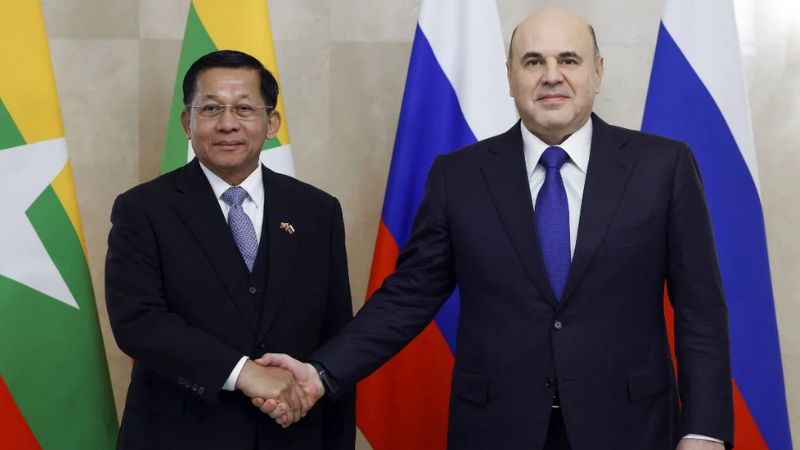
In a high-profile meeting in Moscow, Russia’s Prime Minister Mikhail Mishustin reaffirmed his country’s commitment to deepening ties with Myanmar’s military junta leader, Min Aung Hlaing. The discussions focused on expanding cooperation in nuclear energy, agriculture, transport infrastructure, and investment in Myanmar’s Special Economic Zone in Dawei. This development signals Moscow’s broader geopolitical strategy to solidify its influence in Southeast Asia amid ongoing Western sanctions.
Strategic Partnership in the Face of Sanctions
"Despite the illegitimate sanctions against Russia and Myanmar, our trade and economic cooperation is developing successfully, and mutual trade is growing," Mishustin stated. His remarks underscore how both Moscow and Naypyidaw view each other as key partners in countering Western economic and diplomatic pressure.
Russia’s engagement with Myanmar has grown significantly since the junta seized power in 2021, overthrowing the democratically elected government of Aung San Suu Kyi. Moscow and Beijing have consistently shielded Myanmar’s military from international condemnation, using their veto power at the UN Security Council.
Nuclear Ambitions and Economic Expansion
Russia’s offer to assist Myanmar in building a small nuclear power station, equipped with a RITM-200 pressurized water reactor, marks a significant step in their relationship. If realized, this project could not only meet Myanmar’s energy needs but also deepen Russia’s technological footprint in the region.
Additionally, Russian businesses are planning investments in Myanmar’s long-delayed Dawei Special Economic Zone, an initiative in the Andaman Sea aimed at creating a regional transportation, industrial, and technological hub. This aligns with Russia’s broader Indo-Pacific ambitions to challenge Western economic influence.
Myanmar’s Military as a Russian Ally
Min Aung Hlaing’s visit to Moscow, where he was welcomed by Russian defense officials, highlights the deepening military cooperation between the two nations. The Kremlin announced that new agreements would be signed, further cementing Russia’s role as a crucial arms supplier to Myanmar.
Russia has provided Myanmar’s military with fighter jets, attack helicopters, and air defense systems, bolstering the junta’s ability to suppress domestic opposition. Both nations have also ramped up air force collaboration, a move that worries neighboring ASEAN states already wary of growing militarization.
Regional and Global Implications
Russia’s closer ties with Myanmar could reshape power dynamics in Southeast Asia. The Kremlin’s strategy appears to be twofold: securing economic footholds in Myanmar while countering Western influence in the Indo-Pacific. With China also backing the junta, the growing Moscow-Beijing-Naypyidaw axis presents challenges for ASEAN nations and Western-led initiatives aimed at pressuring Myanmar’s military rulers.
As Russia deepens its engagement in Myanmar, regional actors, including India, Japan, and ASEAN, will likely reassess their diplomatic strategies to navigate the shifting geopolitical landscape. Meanwhile, Western nations, particularly the US and EU, are expected to tighten sanctions against both Russia and Myanmar, further polarizing the global order.
With military cooperation, economic investments, and nuclear technology now on the table, Russia’s influence in Myanmar is set to grow, reshaping Southeast Asia’s geopolitical landscape in the years ahead.
BOB Post